Millie Summary:
- A technically successful AI application is not necessarily a profitable one. The strongest opportunities address production constraints that have measurable consequences for throughput, quality, costs, or margins.
- As AI technology becomes more accessible, manufacturers can create a competitive advantage by applying the knowledge embedded in their equipment, production histories, and engineering processes.
- Before investing, manufacturers should identify the operational problem they want to solve, determine how company-specific knowledge can make AI valuable, and consider what it will take to sustain that value over time.
Written by Nicole DerMarderosian, Growth Development Analyst
What Separates a Good Factory from a Great One?
Imagine two plants producing the same component with similar equipment, staffing, and quality standards. Both meet their delivery commitments, but one consistently produces less scrap, experiences fewer interruptions, and completes production runs with less rework. Over time, those differences determine how much usable output each facility produces from the same resources and, ultimately, how profitably it operates.
Manufacturers have spent decades pursuing these improvements through automation, process optimization, and continuous improvement. Artificial intelligence now offers new opportunities to advance that work. For many manufacturing leaders, the question is becoming increasingly important: Are we investing in AI simply to keep pace with the industry, or because we’ve identified an opportunity to improve how our business performs? That question is particularly relevant for manufacturers whose operations are already efficient and consistently meeting performance standards.
Considering the vast amounts of data produced on the factory floor, there’s no shortage of potential AI use cases. What matters more is determining which operational problems are worth addressing and whether AI offers a meaningful advantage over existing approaches.
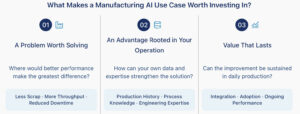
To identify which AI use cases are worth investing in, manufacturing leaders should consider three questions:
- What operational outcome are we trying to improve?
- How can our company-specific data and operational expertise create a distinctive advantage through AI?
- And, what will it take to sustain that value?
The Problem Hiding in Plain Sight
Every manufacturing operation has opportunities for improvement, though some are easier to recognize than others. Recurring production issues may be well understood, while smaller inefficiencies can become part of the daily routine. AI offers new ways to address these challenges, but recognizing where it can make the greatest difference begins with understanding the operation itself.
The people closest to production often have the clearest understanding of where improvements are needed. They know which problems repeatedly interrupt work, where processes fall short, and what it takes to keep production running effectively. An AI platform does not arrive with that understanding of a facility’s priorities. The experience of plant managers, engineers, and operators is essential to identifying where the technology can create meaningful value.
Consider a manufacturer experiencing recurring quality defects. AI can help engineers connect inspection results with production conditions to identify underlying causes and reduce rework. For another manufacturer, the greater opportunity may be anticipating equipment failures that disrupt production and limit capacity. Both applications offer value, but their importance depends on the specific operation and its business priorities.
With so many potential applications, the opportunity lies in identifying which ones best support the manufacturer’s strategic goals. Being selective allows manufacturers to focus their investments where the potential return is greatest.
Once those priorities are clear, the next question is how the manufacturer’s own data, processes, and operational expertise can make the chosen applications more valuable.
The Knowledge Competitors Cannot Buy
As AI technology becomes more accessible, manufacturers can increasingly use the same platforms and analytical tools. This presents an opportunity to build on something competitors cannot easily replicate: years of production experience and knowledge specific to their operations. Even when companies invest in similar technologies, the results can vary considerably depending on how effectively they apply that knowledge.
Much of this knowledge is developed through daily production. Historical data records how equipment and processes have performed, while engineers and operators understand the conditions behind those results, including why certain adjustments work and others don’t. That understanding is shaped by the particular conditions of each facility and cannot simply be purchased alongside an AI platform.
When manufacturers bring this experience together with their production data, AI can help uncover relationships that might otherwise go unnoticed and support decisions grounded in how their facilities actually operate. These insights can inform applications tailored to specific production requirements, making the technology more relevant to the business and its goals.
This is also where the decision to build or buy becomes important. Commercial AI platforms offer a starting point, while custom development can help incorporate specialized processes and operational knowledge that standard solutions may not fully accommodate. Manufacturers can draw on both approaches, choosing how much customization is needed based on the application and the value it is expected to deliver.
Creating Value That Lasts
For manufacturers already meeting production targets, the case for investing in AI may be less obvious. Yet even well-performing operations have room to improve, and small gains in efficiency or capacity can have a meaningful effect on margins when sustained over time.
Once an AI application is aligned with a specific business goal, manufacturers should consider how its benefits can be sustained in daily production:
- Measure the improvement: Establish a baseline and track whether the application continues to improve the outcomes that matter, such as production time, material waste, or operating margins.
- Make it part of daily operations: Ensure the application works with existing systems and processes so employees can use it consistently without creating additional work.
- Plan for change: Consider how the application will be maintained and adjusted as equipment, production requirements, and business priorities evolve.
These considerations help manufacturers look beyond the initial success of an AI application and understand its potential contribution to the business over time. A small improvement in production efficiency, for example, may seem modest on its own, but when repeated across production runs, it can free up capacity, reduce waste, and improve margins without requiring additional equipment or resources.
Over time, it is the ability to identify, sustain, and build on these improvements that can separate a good factory from a great one.
Before the Next Investment
Manufacturers have more opportunities to apply AI than ever before, and that gives them room to be selective. With years of production data and firsthand operational experience to draw from, they are well positioned to make informed decisions about where the technology belongs and how it can support their future growth.
As AI becomes a more established part of manufacturing, the companies that benefit most won’t necessarily be those adopting it the fastest. They’ll be the ones that recognize where it can make a meaningful difference and turn those opportunities into lasting improvements.
A successful AI deployment shows that the technology works. A successful AI investment shows that the business is better because of it.
To continue the conversation about the future of AI in manufacturing and its practical applications, contact Nicole DerMarderosian and the MILL5 team at nicoled@mill5.com.
Frequently Asked Questions (FAQs)
- How do manufacturers decide which AI use cases are worth investing in? Manufacturing leaders can evaluate potential AI use cases with three questions. What operational outcome are we trying to improve? How can our company-specific data and expertise create a distinctive advantage? What will it take to sustain the value? Use cases that clearly answer all three are the strongest candidates for investment.
- Is AI worth it for manufacturers that already meet their production targets? Yes. Even well-performing plants have room to improve, and small gains in efficiency or capacity add up across production runs. Over time, those gains can free up capacity, reduce waste, and improve margins without additional equipment or resources.
- What are common AI use cases in manufacturing? Two common applications are reducing quality defects and predicting equipment failures. AI can help engineers connect inspection results with production conditions to find the root causes of defects, or anticipate equipment problems before they disrupt production. Which one matters more depends on the operation and its business priorities.
- Why does operational expertise matter for manufacturing AI? An AI platform doesn’t come with an understanding of a facility’s priorities. Plant managers, engineers, and operators know which problems interrupt production and why certain adjustments work. When that knowledge is combined with production data, AI can surface insights grounded in how the facility actually runs.
- Should manufacturers build custom AI or buy a commercial platform? Many manufacturers use both. Commercial AI platforms provide a solid starting point, and custom development by the MILL5 team can bring in specialized processes and operational knowledge that standard tools may not handle. How much to customize depends on the application and the value it’s expected to deliver.
- How can manufacturers sustain the value of an AI investment? Start by setting a baseline and tracking outcomes such as production time, material waste, or operating margins. Integrate the application with existing systems so employees can use it without extra work, and plan for maintenance as equipment, production requirements, and priorities change.