
Key Takeaways:
- AI spending is growing much faster than the returns it produces. Gartner forecasts $2.67 trillion in worldwide AI spending for 2026, up 49.5%. Yet only 37% of companies attribute any EBIT impact to AI, essentially unchanged from 39% a year earlier.
- The gap sits between the model and the P&L, not in the technology. When business cases count usage as value, leave out full lifecycle cost, and never turn time savings into lower spend, a growing share of the technology budget buys activity instead of earnings. Boards, CFOs, and investors will notice the difference.
- Manage AI as a capital-allocation portfolio, not a technology program. Tie every use case to a P&L line with a finance-approved baseline, a named owner, and a threshold for stopping it. Price the full lifecycle before funding and pay for the next wave from what you retire.
Written by Jordyn Geiger, Growth Development Analyst
Part 1 of a six-part MILL5 series on converting AI and technology spend into enterprise value.
Boards are approving AI budgets on the assumption that adoption leads to earnings. So far, the evidence says adoption mostly leads to more adoption.
Gartner now forecasts worldwide AI spending of $2.67 trillion in 2026, a 49.5% increase over 2025, with $1.48 trillion of that in AI infrastructure, $576 billion in AI services, and $462 billion in AI software. Its broader forecast puts total IT spending at $6.39 trillion in 2026, up 14.5%, crossing $7 trillion in 2027. The two figures overlap and should not be added, and much of the infrastructure line is hyperscaler build-out rather than enterprise budget. The direction is still unambiguous. On the investment side, Stanford’s 2026 AI Index puts global corporate AI investment at $581.7 billion in 2025, up 130% from the prior year.
Now the other side of the ledger. McKinsey’s 2026 State of AI survey finds that nearly nine in ten organizations use AI regularly in at least one function, and eight in ten respondents say it has improved their personal productivity. Yet only 37% attribute any EBIT impact to AI, essentially unchanged from 39% in the 2025 survey. The share McKinsey classifies as high performers; those attributing 5% or more of EBIT to AI, has stayed at about 6%. Fewer than half (44%) say AI is scaling across the enterprise.
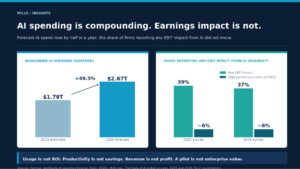
That is the AI capital-efficiency gap: spend is growing at roughly 50% a year while the share of firms that can point to earnings impact has not moved. It is rarely a model problem. The gap sits between the model and the P&L.
Where the Value Leaks
The leaks occur at predictable points in the life of an AI investment; they demo well, not because they touch a cost or revenue line large enough to matter. The business case then prices licenses and tokens while excluding the work that makes a model usable in production: data preparation, integration, validation, monitoring, security review, human review, change management, and eventually decommissioning. From the first board slide, the investment looks cheaper than it is.
Post-launch, the problem moves from the spreadsheet to the operating floor. Adoption is often shallow, with the new tool in use while the old spreadsheet keeps running beside it. Separate departments buy overlapping copilots, model gateways, and data platforms for the same users. Drift and degraded retrieval push review labor up over time and quietly reverse the savings the case was built on. Consumption pricing and provider concentration then change the economics after the contract is signed. McKinsey reports that about one in five organizations already say AI operating costs, including tokens, are constraining their use.
The most common leak, and the least discussed, is time saved that never becomes money. Consider an illustrative case: an assistant that saves 200,000 employee hours a year has produced capacity, not savings. It reaches EBITDA only when management decides to reduce overtime, contractors, or headcount, cancel planned hiring, absorb more volume at the same cost, or redeploy the capacity into work with a measurable return. Without that decision, the operating expense does not move.
Four distinctions should sit at the top of every AI investment review: Usage is not ROI. Productivity is not savings. Revenue is not profit. A pilot is not enterprise value.
What the Leaders Do Differently
The firms closing the gap are not spending less. McKinsey’s high performers are more than twice as likely as others to spend over 15% of their technology budget on AI. Nearly three-quarters have fundamentally redesigned workflows around AI, compared with one-quarter of other respondents, and they are twice as likely to have defined processes for measuring impact. Spend without redesign and measurement does not convert.
Finance teams are reaching the same conclusion. The FinOps Foundation’s State of FinOps 2026 reports that 98% of practitioners now manage AI spend, up from 31% two years ago, and that many organizations are being asked to fund new AI investment from optimization savings. That is the right instinct. An AI budget that must be earned from cloud waste, and redundant software forces the discipline that most AI business cases lack. Capital discipline, not capital volume, is the durable AI advantage.
The Spend-to-Enterprise-Value Loop
Closing the gap takes a management system that follows each AI dollar from approval to realized cash flow. This series is built around one framework that treats AI as a portfolio of capital investments, not a set of technology projects. Each stage poses a question the executive committee should be able to answer and ends in a decision:
- Inventory spend: What are we actually buying and operating?
- Define the value hypothesis: What business outcome should each investment create?
- Assess technical and model risk: Can the system perform reliably under expected and stressed conditions?
- Assess adoption and organizational risk: Will people use it correctly and change how work is done?
- Measure realized economics: Are benefits appearing in revenue, cost, risk reduction, or cash flow?
- Benchmark competitively: Are we creating more value per dollar than peers or alternatives?
- Consolidate the portfolio: Which applications, models, data assets, and vendors are redundant?
- Translate to financial value: Does the result improve sustainable EBITDA, cash flow, or growth?
- Reassess continuously: Have the model, the economics, the market, or the risks changed?
It is a loop, not a funnel. A use case that passes model validation can still fail on adoption. Most organizations run stages 2 and 3 reasonably well and skip 5, 7, and 8, which is where earnings are made or lost.
The MILL5 View: Strategy, Build, Operate
Strategy – Decide what AI is for
Start with a single AI investment register that covers every model, copilot, platform, contract, owner, and cost line. Without one, no one can say with confidence what the AI program actually costs. Every initiative should then carry a value hypothesis tied to a specific P&L line, a baseline that finance has signed off on, and a threshold at which it stops. Benefits should be reported by category: realized cash savings, released capacity, cost avoidance, incremental gross profit, and loss avoidance. Blending them is the fastest way to inflate a board deck.
Build – Engineer for the full cost and the new workflow
Price the full lifecycle before funding, including inference, data, integration, validation, security, monitoring, human review, and exit. The workflow change belongs in the build, not after go-live, so roles, handoffs, review thresholds, and the legacy step being retired should be designed alongside the system. Instrumentation starts on day one. Cost per completed task, override rate, rework, and review time belongs in the product itself, not in a post-launch study that arrives after the budget is spent.
Operate – Run AI as a production cost line
Once live, AI should be managed like any other variable production cost. That means applying FinOps discipline to token, inference, and GPU spend, allocating it to the business units that consume it, and reviewing unit economics monthly. MLOps monitoring should track drift, groundedness, and provider outages, backed by runbooks and 24×7 incident response. A quarterly portfolio review then decides what to scale, renegotiate, consolidate, or retire, and the next wave of investment is funded from what gets cut.
Buy-side firms, broker-dealers, and sell-side institutions already validate quant and credit models rigorously. Few apply the same discipline to the economics of generative and agentic AI, where the cost base is variable, and the benefit depends on a workflow change no one has been assigned to make.
Bottom Line
AI spending will keep rising. The question for boards, CFOs, and operating partners is whether earnings rise with it. The winners will not be the firms that spend the most, but the ones that can show, line by line, how spend becomes cash flow.
The rest of this series works through the loop: why usage is not ROI (Part 2), AI Value-at-Risk as a stress test for the business case (Part 3), where value leaks inside the organization (Part 4), value per dollar as the real benchmark (Part 5), and the path from consolidation savings to EBITDA and enterprise value (Part 6).
To discuss how to close the AI capital-efficiency gap across your technology portfolio, contact Jordyn Geiger at jordyng@mill5.com.
Frequently Asked Questions (FAQs)
- Why isn’t enterprise AI spending improving earnings? Enterprise AI spending often fails to improve earnings because value leaks between the model and the profit and loss statement (P&L). Gartner forecasts worldwide AI spending of $2.67 trillion in 2026, up 49.5% from 2025. Yet McKinsey’s 2026 State of AI survey found that only 37% of organizations attribute any earnings before interest and taxes (EBIT) impact to AI. MILL5 calls this the AI capital efficiency gap. Common causes include business cases that leave out integration and monitoring costs, shallow adoption, and overlapping tools.
- What is the Spend-to-Enterprise-Value Loop? The Spend-to-Enterprise-Value Loop is a MILL5 framework that manages AI as a portfolio of capital investments and follows each AI dollar from approval to realized cash flow. Its nine stages are inventory spend, define the value hypothesis, assess technical and model risk, assess adoption and organizational risk, measure realized economics, benchmark competitively, consolidate the portfolio, translate to financial value, and reassess continuously. Most organizations handle the value hypothesis and technical risk reasonably well but skip measurement, consolidation, and financial translation, which is where earnings are made or lost.
- How does time saved by AI turn into cost savings? Time saved by AI becomes cost savings only when management decides how to use the freed capacity. For example, an AI assistant that saves 200,000 employee hours a year has created capacity. That capacity reaches earnings before interest, taxes, depreciation, and amortization (EBITDA) only when leaders reduce overtime, contractors, or headcount, cancel planned hiring, absorb more volume at the same cost, or move people into work with a measurable return. Without one of those decisions, operating expenses stay the same.
- When should a company review its AI investments? A company should review its AI investments when AI spending is rising but finance cannot trace it to revenue, cost, or cash flow. Warning signs include having no single register of AI models, copilots, and contracts, having separate departments buy overlapping tools, and reporting benefits as usage or productivity instead of realized savings. MILL5 helps organizations close this gap through a Strategy, Build, Operate approach that combines an AI investment register, full lifecycle costing, and financial operations (FinOps) discipline for token, inference, and graphics processing unit (GPU) spend.