
Millie Summary:
- High model accuracy doesn’t guarantee reliable performance. MedTech AI can learn misleading patterns from training data rather than the clinical characteristics it’s intended to recognize.
- Reliable AI depends on accurately connecting medical images, measurements, and device data while preserving the context and timing needed for meaningful predictions.
- AI performance must be continuously validated and monitored as real-world conditions change, with traceable data pipelines and controlled updates supporting long-term reliability and regulatory compliance
Written by Ava Iannessa, Growth Development Analyst
Could your model’s high-test accuracy be hiding its failure to recognize the abnormality it was trained to detect?
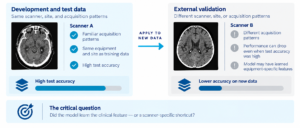
A medtech AI model can achieve high test accuracy by recognizing a scanner’s image characteristics instead of the anatomy or abnormality it was trained to identify. When images come from a different scanner, accuracy can drop because the model relied on equipment-specific patterns that its test data did not challenge.
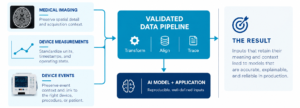
That risk begins with preparing different types of data for the same learning task. Medical scans, numerical measurements, and device events each require processing that preserves their meaning and allows them to be interpreted together. An image paired with a measurement from a different operating state can pass through the pipeline even though the association misrepresents the conditions the model is meant to learn.
For that reason, reliable medtech AI requires the same engineering discipline around the data pipeline as around the model. Teams need to validate how inputs are prepared and combined, then monitor whether those assumptions continue to hold in production. In a highly regulated industry like healthcare, this work provides evidence to support deployment and subsequent changes.
Key Takeaways
- High test accuracy can hide a model that learned scanner or site artifacts instead of the abnormality.
- Images and measurements must be aligned by acquisition time, not recording time.
- Training data must exclude information recorded after the prediction point.
- Validation should cover the scanners, sites, and conditions of the intended use.
- Production monitoring should track rejected inputs and preprocessing changes, not just accuracy.
Preparing Different Data Types Before Training
Data preparation starts with deciding which properties must survive transformation. Numerical measurements need consistent units and acquisition information, while visual processing must retain the spatial detail relevant to the task. The resulting inputs must also be linked to the correct device, procedure, or event.
A shared platform makes those inputs accessible, but the model still needs a representation that supports learning across them. Multimodal architectures can process different data types through separate encoders before combining their features. Teams must evaluate where that combination occurs and how much each input contributes, including how the application behaves when a source is unavailable.
Training examples must reflect the information available when a prediction would be made. If they include status updates recorded afterward, the model gains access to future information, making its ability to anticipate events appear stronger than it is. Acquisition metadata helps engineers identify and exclude those updates from the model’s inputs.
These preparation rules need to be reproducible. Retaining the source records, transformations, and labeling methods used for each model version gives engineers a basis for investigating whether unexpected behavior originates in the model or its inputs.
Connecting Medical Imaging and Measurements Over Time
For applications that combine imaging with measurements, the sequence around an image can be as important as the image itself. Numerical history can help describe how conditions developed before capture or changed afterward, provided it is aligned with the visual input and relevant to the intended task.
Time-series databases support that alignment by organizing timestamped measurements for retrieval over defined windows. Temporal queries and time-based aggregation reduce manual preparation work, while large image files can remain in object storage linked through identifiers and acquisition timestamps. This architecture is especially useful for workloads that repeatedly query continuously arriving measurements.
However, retrieval alone does not establish that the records describe the same moment. Engineers must account for differences in sampling frequency and delays between acquisition and recording. If recording time is used to align a delayed measurement with an image, a technically successful join can connect observations from different operating states.
Testing should establish whether numerical history improves performance beyond the visual input alone and whether the application remains reliable when a measurement is missing or delayed. Applying compatible alignment rules during training and deployment makes that comparison meaningful.
Validation Has to Establish What the Model Learned
Even with those safeguards, a reproducible pipeline can produce misleading results if the model relies on an acquisition artifact. The FDA describes this problem in its January 2025 draft guidance on AI-enabled device software functions, noting that an image-recognition model can learn features associated with a particular scanner or clinical site rather than generalizable patient characteristics. The draft also identifies a potential confounder when images of diseased cases consistently include a ruler.
When such correlations appear in both development and test data, high accuracy does not establish that performance will hold elsewhere. Validation needs to challenge those dependencies across the acquisition conditions relevant to the intended use, rather than simply reproduce the conditions present during training.
The FDA’s Good Machine Learning Practice resources point to the 2025 IMDRF principles, which emphasize representative datasets and independence between training and test sets. Repeated observations from the same patient or procedure require more care than randomly dividing records. Evaluation also needs to reflect the intended use environment and how users interact with the device.
The intended use determines the regulatory considerations. AI-enabled device functions and internal decision-support applications require different assessments, but both need evaluation of the complete application under realistic input conditions. Model metrics must be interpreted alongside the decisions the output supports and the consequences of an error.
The Data Context Continues to Change in Production
After deployment, changes to image processing, measurement units, or event definitions can alter the inputs a model receives, even when the model itself remains unchanged. Endpoint availability alone does not reveal whether production inputs still reflect the conditions under which performance was established.
MLOps must connect those changes to application performance. A rise in rejected inputs deserves attention because stable accuracy on accepted inputs can obscure declining coverage. Monitoring should help engineers identify affected records and investigate whether the change originates in acquisition, preprocessing, or model behavior.
That investigation also depends on feedback that can arrive later than the prediction, particularly when an outcome requires expert review or a completed event. Teams need to reconcile predictions with their outcomes and retain enough information to investigate failures. Input monitoring provides an early signal, but it cannot replace evaluation against the outcome the model is meant to predict.
Linking preprocessing and model versions makes the investigation reproducible and helps teams determine whether retraining addresses the cause. For regulated device functions, any resulting update remains subject to the applicable validation and change-control process. Newly collected data can support evaluation without automatically changing the deployed model.
MILL5’s Approach
MILL5’s Strategy, Build, and Operate framework connects these responsibilities across the AI lifecycle.
Strategy establishes how different data types will support the intended AI use case. MILL5 assesses whether images, measurements, and device records can be reliably connected, then defines the architecture and validation approach needed to test their contribution.
Build puts that design into practice. MILL5 develops pipelines that preserve image detail, standardize numerical measurements, and align records using acquisition timestamps and shared identifiers. These pipelines connect to the model and application through repeatable testing and deployment practices, keeping data transformations traceable.
Operate maintains those pipelines and models through MLOps, combining 24/7 operational monitoring with ongoing performance evaluation. MILL5 investigates whether changes in image processing, measurement quality, or data timing affect predictions and determines whether the response requires a pipeline correction or a validated model update. As usage grows, we also optimize processing and compute costs while maintaining the performance the application requires.
Medtech teams need AI whose behavior can be traced to its inputs and evaluated as conditions change. Preserving the information that connects observations to their acquisition conditions and intended use makes it possible to investigate failures and maintain the capability throughout its lifecycle.
For a complimentary strategy session on building reliable, scalable MedTech AI, contact Ava Iannessa and the MILL5 team at avai@mill5.com.
Frequently Asked Questions (FAQs)
- Why can a medtech AI model have high accuracy but fail in the real world? It may have learned features of the scanner, clinical site, or acquisition setup rather than the anatomy or abnormality. If test data shares those artifacts, accuracy looks high until images come from different equipment.
- What is data leakage in medtech AI? It’s when training data includes information that wouldn’t be available at prediction time, such as status updates recorded after an event. It makes predictive performance look stronger than it is.
- How should training and test data be split for medical AI? Split by patient or procedure rather than by random records, so repeated observations from the same patient don’t appear in both sets.
- What does the FDA say about AI models learning scanner-specific features? Its January 2025 draft guidance on AI-enabled device software functions notes that image models can learn features tied to a scanner or site rather than patient characteristics, and gives a ruler appearing in diseased-case images as an example of a confounder.
- What should be monitored after a medtech AI model is deployed? Changes in image processing, measurement units, event definitions and rejected-input rates, plus predictions reconciled against later outcomes.