
Millie Summary:
- AI is reshaping the economics of pharmaceutical R&D by improving scientific decision-making, helping researchers evaluate more possibilities, eliminate weaker candidates earlier, and concentrate expensive laboratory and clinical resources on the opportunities supported by the strongest evidence.
- For medical-aesthetics manufacturers, the larger opportunity is increasing scientific throughput across the entire product lifecycle, from discovery and formulation through patient segmentation, expanded indications, clinical development, and continued product innovation.
- The organizations that gain the greatest advantage from AI will not simply have the best models; they will have the strongest foundations, connecting proprietary scientific data, modern architecture, responsible governance, and AI-enabled workflows to accelerate R&D and extract greater value from decades of intellectual property.
Written by Gabrielle Silva, Office Administrative Assistant
Medical aesthetics is typically discussed at the point where innovation becomes visible: a new neuromodulator enters the market, a filler earns an expanded indication, a biologic demonstrates differentiated clinical performance, or a novel treatment changes how providers approach patient care.
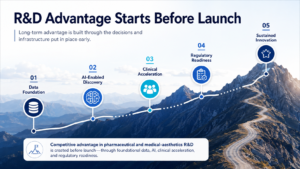
Yet the competitive advantage behind those launches is established years before commercialization.
It is built through a sequence of consequential decisions: which biological targets warrant investigation, which molecules merit continued investment, which experiments should be prioritized, and where increasingly expensive scientific resources should be deployed.
The economics surrounding those decisions are unforgiving. Only approximately 12% of drugs entering clinical trials ultimately receive approval, while successful therapies require roughly 11 years, on average, to develop. When capital costs and unsuccessful programs are included, estimates for developing a single new drug range from less than $1 billion to more than $2 billion.
Artificial intelligence and machine learning introduce an opportunity to reshape that equation.
Not because AI eliminates biological uncertainty. It does not.
Its more consequential value lies in improving the speed, scale, and quality of scientific decision-making, helping researchers evaluate more possibilities before capital is committed, identify weak candidates earlier, extract greater value from proprietary research, and reduce the technical friction surrounding increasingly data-intensive R&D.
For medical-aesthetics organizations competing through sustained product innovation, indication expansion, and scientific differentiation, that capability could become a meaningful source of competitive advantage.
Drug Discovery Is Fundamentally a Decision Problem
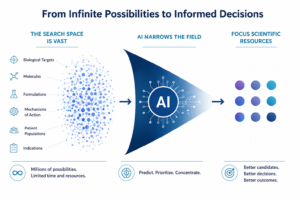
Drug discovery begins with an immense search space.
Researchers must navigate biological targets, molecular structures, formulations, mechanisms of action, safety profiles, pharmacokinetic characteristics, patient populations, and possible indications. It is neither technically nor economically feasible to test every possibility experimentally.
Pharmaceutical R&D is therefore, at its core, an exercise in progressively reducing uncertainty.
AI changes how efficiently that reduction can occur.
Machine-learning models can interrogate biological and chemical datasets for patterns that may be difficult to identify through conventional analysis. Predictive models can estimate molecular activity, toxicity, binding affinity, pharmacokinetics, and developability before a candidate advances. Generative models can propose new molecular structures optimized against predefined characteristics, while knowledge graphs can connect findings dispersed across literature, patents, experiments, clinical data, and proprietary research.
Rather than relying exclusively on physical experimentation to determine which candidates fail, organizations can increasingly use computational intelligence to determine which candidates warrant experimentation in the first place.
In one accelerated-discovery program, researchers combined generative AI, deep-learning classifiers, and molecular simulations to identify, synthesize, and experimentally test 20 novel antimicrobial peptide candidates within 48 days. Two demonstrated high potency across multiple pathogens, including a multidrug-resistant strain.
The significance extends beyond those individual compounds.
Traditional pharmaceutical development depends heavily on experimentation to eliminate weak hypotheses. AI introduces an additional layer of selection before expensive laboratory and clinical resources are deployed.
If lower-potential candidates can be deprioritized computationally, scientific capacity can be concentrated on opportunities supported by stronger evidence.
In other words, AI has the potential to change not only how quickly pharmaceutical organizations succeed, but how cheaply they fail.
And in an industry where unsuccessful programs account for a substantial portion of total R&D expenditure, earlier failure can itself create economic value.
The Larger Opportunity Is Scientific Throughput
Cost reduction is one of the most intuitive arguments for AI adoption.
But evaluating AI primarily through headcount reduction or task automation understates what may be its more consequential contribution to pharmaceutical R&D: increasing the amount of high-value science an organization can conduct with the resources it already possesses.
One global pharmaceutical R&D organization has built an AI-enabled reasoning environment on top of more than 200,000 patient-years of harmonized clinical trial data. Exploratory analyses that previously required weeks can now be completed in minutes, while teams that once had capacity to pursue approximately five to ten strong ideas per quarter can evaluate more than 50.
That fundamentally changes the business case.
The value is not simply that an existing analysis becomes less expensive to perform.
It is that the same R&D organization can investigate more hypotheses, invalidate weaker ideas earlier, identify higher-potential opportunities faster, and make better-informed decisions about where capital should be deployed.
In an industry where only a fraction of clinical candidates ultimately reach commercialization, increasing the volume and quality of decisions at the front end of development can influence the economics of the entire portfolio.
The most meaningful measure of AI value in R&D may therefore be less about labor eliminated and more about innovation capacity created.
Proprietary R&D Data Becomes a Strategic Asset
There is, however, a critical constraint.
An AI model does not inherently understand an organization’s science.
The pharmaceutical companies most likely to create differentiated value from AI will be those capable of combining sophisticated models with proprietary scientific knowledge accumulated over years or decades.
At one dermatology-focused pharmaceutical organization, more than 50 years of R&D knowledge across approximately 400,000 documents had become fragmented across languages, systems, and repositories. Researchers frequently spent hours, or even days, locating prior experiments and historical research.
An AI-enabled research environment made that institutional knowledge searchable in seconds. Users reported receiving accurate answers approximately 80% of the time, while experiments that could previously consume half a day of manual investigation could be surfaced in minutes. The result was less duplicated research, faster scientific decision-making, and shorter R&D cycles.
This represents a particularly important form of scientific efficiency.
A researcher spending hours locating an experiment conducted a decade earlier is not producing new knowledge. If the experiment cannot be found at all, the organization risks reproducing work it has already performed.
AI can transform institutional knowledge that technically exists, but remains operationally inaccessible, into actionable scientific intelligence.
For medical-aesthetics manufacturers with decades of research spanning formulations, toxins, biologics, skin biology, injection science, clinical outcomes, and product performance, that accumulated knowledge may ultimately prove more strategically valuable than access to any individual AI model.
Medical Aesthetics Has a Distinct R&D Opportunity
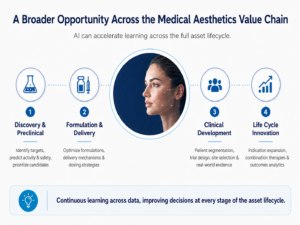
The opportunity is particularly relevant to medical aesthetics because innovation frequently extends well beyond the discovery of a single molecule.
Manufacturers continuously evaluate formulation improvements, delivery mechanisms, dosing strategies, combination therapies, patient segmentation, expanded indications, and differentiated clinical endpoints. The commercial life of an asset can depend on how effectively an organization continues to generate evidence around it.
That creates multiple opportunities for AI and machine learning.
Models can help identify relationships across experimental and clinical datasets, surface promising patient subgroups, analyze historical treatment performance, support indication prioritization, and augment the interpretation of increasingly sophisticated imaging and visual-outcome data.
The strategic opportunity is therefore broader than accelerating initial discovery.
It is about building an R&D environment capable of learning continuously across the lifecycle of an asset—from early hypothesis generation through clinical development, commercialization, and subsequent innovation.
AI Continues Creating Value After Discovery
The economic opportunity does not end when a promising candidate leaves the laboratory.
Clinical development introduces another layer of complexity involving sponsors, investigators, research sites, laboratories, regulators, patients, and enormous volumes of operational and scientific information.
AI can support site selection, enrollment forecasting, trial documentation, predictive monitoring, protocol intelligence, and the analysis of increasingly large clinical datasets.
In one large clinical-development environment, AI-driven analysis reduced site-activation cycle time by approximately 10%. An initial list of potential clinical sites that historically required an extensive manual process can now be generated within approximately 24 to 48 hours, with the broader selection process narrowed to weeks.
For pharmaceutical organizations, compressing these operational timelines has implications beyond administrative efficiency.
Faster trial execution can accelerate evidence generation, shorten the path to regulatory milestones, and allow capital and scientific resources to be redirected sooner toward the next development decision.
Time itself becomes an economic variable.
The Model Is Not the Hard Part
The promise of AI, however, creates a familiar enterprise challenge.
Access to increasingly capable models is becoming democratized.
Access to trusted, connected, governed, scientifically meaningful proprietary data is not.
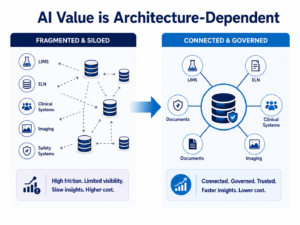
Pharmaceutical R&D environments frequently span laboratory information systems, electronic notebooks, clinical platforms, data warehouses, imaging repositories, safety systems, regulatory applications, external research partners, and decades of legacy technology.
Every isolated repository and point-to-point integration introduces additional friction between information and the scientists attempting to use it.
This is where AI strategy becomes inseparable from data architecture.
One major clinical-research organization consolidated information from more than 100 data sources into a modernized data environment. The transformation produced an 85% reduction in data-engineering tooling costs, a 30% increase in staff efficiency, and a 70% reduction in time to market for data products, while simultaneously establishing a stronger foundation for predictive analytics and AI.
The implication for pharmaceutical leadership is significant.
The architecture required to support AI does not necessarily have to become another layer of technology expense.
When modernization is approached strategically, it can reduce redundant tooling, simplify integrations, strengthen governance, improve data accessibility, and establish the foundation required for more advanced intelligence.
Technical modernization and AI innovation are not separate strategies.
In mature R&D environments, one increasingly enables the other.
What This Looks Like in Practice
MILL5 has seen this same architectural principle play out within highly regulated healthcare environments.
In its work with Olympus, MILL5 integrated AI and machine learning into a connected smart-operating-room ecosystem, combining device data, cloud infrastructure, edge computing, and analytics while keeping sensitive information appropriately secured.
The resulting platform enabled real-time operational intelligence that could anticipate procedure timing, identify patient movement, improve room availability, and support more efficient clinical workflows. The implementation ultimately reduced operating-room turnover time by 30% and helped consolidate infrastructure in a way that reduced operating costs by millions of dollars.
The use case is different from pharmaceutical discovery, but the architectural lesson is the same.
AI does not create meaningful enterprise value simply because a model has been introduced. Value emerges when trusted data, modern infrastructure, machine learning, security, and operational workflows are designed as a connected system.
For pharmaceutical R&D, the same principle applies to laboratory data, clinical evidence, scientific documents, imaging, and historical research.
Before organizations can extract intelligence from those assets, they must first make them usable.
Responsible AI Must Be Embedded Into R&D
Pharmaceutical AI also cannot be governed like an unrestricted enterprise chatbot.
Models influencing scientific or clinical decisions require traceability, validated data, defined contexts of use, security, lifecycle monitoring, and appropriate human oversight.
Regulatory expectations are evolving accordingly.
Guidance published in 2026 establishes principles around human-centric design, risk-based validation, data governance, model-performance assessment, cybersecurity, defined contexts of use, and ongoing lifecycle management. At the same time, regulators explicitly recognize AI’s potential to reduce time to market, improve predictions of toxicity and efficacy, decrease reliance on animal testing, and support innovation throughout the drug lifecycle.
Responsible AI should therefore not be treated as a control mechanism applied after innovation occurs.
It must be designed into the R&D environment from the beginning.
Organizations that establish those controls early will be better positioned to move AI from experimentation into increasingly consequential scientific workflows without sacrificing trust, transparency, or regulatory defensibility.
The Next R&D Advantage Will Be Built Before the Product Launch
Medical aesthetics will continue to be defined by science, safety, efficacy, physician trust, patient outcomes, and meaningful product differentiation.
AI does not alter those fundamentals.
It alters how efficiently organizations can pursue them.
The emerging opportunity is not simply to use a model to design a molecule more quickly.
It is to create an R&D organization capable of learning more quickly.
One where computational intelligence narrows the experimental search space before capital is committed. Where decades of scientific knowledge can be retrieved in seconds rather than days. Where researchers can evaluate significantly more hypotheses with the same scientific capacity. Where clinical-development teams move with greater efficiency. And where fragmented technology environments are modernized into reusable foundations for continued innovation.
That is why the financial case for AI in pharmaceutical R&D extends well beyond automation.
It is fundamentally about increasing scientific throughput while reducing the time, cost, and technical friction surrounding each consequential R&D decision.
For medical-aesthetics manufacturers, that creates a new dimension of competitive advantage.
The organizations capable of connecting proprietary scientific data, modern architecture, AI and machine learning, clinical-development systems, and responsible governance will be better positioned to explore more opportunities, eliminate weak hypotheses earlier, accelerate stronger programs, and extract greater value from intellectual property accumulated over decades.
Building the R&D Foundation for What Comes Next
The companies that create the greatest value from AI in pharmaceutical R&D will not simply deploy increasingly sophisticated models.
They will build the data, architecture, governance, and scientific workflows required to make those models useful at scale.
MILL5 helps healthcare and life sciences organizations modernize fragmented technology environments, establish AI-ready data foundations, and build intelligent systems that convert proprietary information into measurable business value.
For medical-aesthetics organizations, that foundation can provide the infrastructure required to accelerate scientific decision-making, reduce technical overhead, unlock previously inaccessible research, and bring AI deeper into the R&D lifecycle.
If your organization is evaluating how AI and machine learning could accelerate pharmaceutical R&D, connect with MILL5 to explore what an AI-ready research foundation could look like for your business.