
Millie Summary:
- U.S. Equities are expected to move to 23×5 trading on December 6, 2026.
- Strategy: Exchange-led 23×5 trading (targeted for late 2026) globalizes access to U.S. equities. The firms that win will decide where overnight participation creates client value – and where it creates risk they refuse to take.
- Build: SIP coverage, order routing, market-data feeds, risk limits, surveillance, and client platforms must treat overnight as a first-class session, not an afterthought bolted onto daytime systems.
- Operate: Thin liquidity, static LULD bands, APAC-driven retail flow, and news-driven gaps mean overnight is an ops and risk problem as much as a trading problem. Staffing, runbooks, monitoring, and incident response must cover the night session – or you should not claim you are open.
Written by Jordyn Geiger, Growth Development Analyst
U.S. equity markets are preparing to trade nearly continuously: roughly 23 hours a day, five days a week, with exchanges targeting an overnight session alongside existing early, core, and late sessions, and a short nightly maintenance window. Alternative trading systems already run overnight books. What changes now is the move from niche ATS overnight flow to exchange-grade infrastructure, including Securities Information Processor (SIP) coverage across the longer day.
For buy-side desks, broker-dealers, and sell-side firms, the wrong question is: Will we support overnight?
The right question is: What does overnight force us to redesign – execution policy, technology, risk, and operations – so we can serve clients without pretending liquidity and controls are the same at 11 p.m. as at 11 a.m.?
MILL5 works with financial institutions that build and run trading, market-data, and operating platforms. Below is how we see 23×5 readiness across Strategy, Build, and Operate – with the distinct pressures on buy-side, broker-dealers, and sell-side.
What Actually Changes
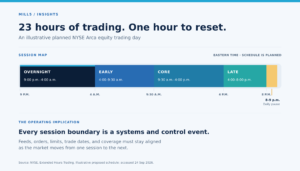
A few facts matter more than the marketing of always-on markets. Overnight trading is expected to move on December 6, 2026 and will run roughly 9 p.m. to 4 a.m. ET, with pre-market from 4 a.m., core hours unchanged, and post-market into the evening, leaving about one hour for maintenance and trade-date transition. ATS venues already cover parts of that overnight window today.
Second, static limit-up / limit-down (LULD) bands tied to reference prices will constrain how far prints can move overnight. That is a feature for investor protection and a constraint when material news hits after the close: the band does not know that fundamentals changed.
Third, overnight ATS activity has grown sharply but overnight remains a fraction of a percent of total U.S. equity volume. Flow has been heavily influenced by APAC retail demand for U.S. names; by share volume, activity concentrates in a short list of names (often low-priced); by dollar value, large-cap tech looks more familiar. Institutions are right to be cautious about size and impact.
Lastly, if clients can trade, competitor platforms are open, and news moves prices while you are dark, optional becomes a client-service and franchise question, not a pure volume question.
23×5 does not magically create deep, institutional-quality liquidity at 2 a.m. It creates a longer surface on which risk, data, and operational failure can show up.
Buy-Side: Participation Is a Policy Decision, Not a Toggle
Asset managers and hedge funds are generally cool on staffing 23-hour desks. That is rational. Core liquidity still clusters around the open and close. Extending the calendar without changing how you allocate, execute, and govern risk can fragment fills and raise market impact.
Buy-side have things to validate before December go-live, such as:
- Mandate clarity: Which strategies may trade overnight (news response, event-driven, APAC-linked flow, ETF hedges) – and which may not?
- Liquidity thresholds: Minimum displayed size, maximum participation rate, and ‘do not cross the spread beyond X’ rules that are stricter overnight than in the core session.
- Benchmark honesty: If you measure traders against a daytime VWAP or close, overnight prints need explicit exception logic. Otherwise, you invent false underperformance – or worse, you incent bad overnight fills to catch up.
- Research and risk handoff: Overnight is when earnings, geopolitics, and issuer news hit. The operating model needs a defined path from alert >> portfolio decision >> order >> post-trade review, even if human coverage is follow-the-sun rather than a full New York night desk.
Strategy for the buy-side is not be first overnight. It is preserve capital and client outcomes when the tape is open and thin.
Broker-Dealers: You Are the Translation Layer
Introducing brokers, executing brokers, and retail/institutional platforms sit in the middle: client demand (including international introducing brokers), exchange/ATS connectivity, best-execution narratives, and surveillance obligations. Pressure points are:
- Best execution in a thin book: Wider spreads and sparse depth are not a marketing footnote. Client disclosures, order types (often limit-only overnight), and routing logic must reflect reality – including when not to send size overnight.
- Market data and SIP dependency: Exchange 23×5 assumes SIP readiness for the longer day. Your platforms, algo wrappers, and client UIs must consume the right session identifiers, timestamps, and corporate-action cutovers across the maintenance hour – or you will misprice, mislabel trade dates, or show stale state.
- Credit, limits, and abuse controls: Overnight retail-led spikes in low-priced names are a known pattern on ATS venues. Risk engines that only tighten during the core session will miss the session where retail concentration and gap risk are highest.
- Client segmentation: APAC retail access via global brokers is a growth story. U.S. institutional clients may want access without obligation. Product and platform design should separate ‘can trade’ from ‘should trade,’ with clear defaults by client type.
Broker-dealers that treat overnight as a checkbox on the order ticket will generate tickets – and complaints. Firms that rebuild the control plane (limits, routing, disclosure, surveillance) will keep franchise trust.
Sell-Side: Liquidity, Franchise, and the News Window
Market makers, agency desks, and sell-side research/sales coverage feel the tension the SEC preparedness roundtables and industry forums have already flagged: overnight can improve the ability to react when news breaks, but an open market with sparse liquidity can amplify volatility in market-moving events. Priorities are as follows:
- Inventory and quoting policy by session: Separate risk budgets for overnight versus core. Do not inherit daytime quote obligations into a session where hedging is expensive or impossible in size.
- Event playbooks: Pre-define behavior for overnight earnings, FDA/regulatory headlines, index events, and geopolitical shocks – including when to widen, pull, or only provide indication.
- Franchise vs. P&L: Some overnight flow will be unattractive on a pure economics basis but strategically important for client coverage. Make that call explicit in desk policy so traders are not improvising franchise decisions at 1 a.m.
- Surveillance continuity: Spoofing, layering, and wash patterns do not sleep because the New York desk went home. Alerting and escalation must follow the session, not the org chart.
The MILL5 View: Strategy, Build, Operate
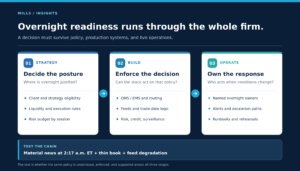
At MILL5, we treat 23×5 as a cross-tower problem. Technology alone does not make a firm overnight-ready. Neither does a policy memo.
Strategy – Decide the overnight posture
- Map client segments (U.S. institutional, U.S. retail, APAC-introduced retail, corporate issuers, market-making counterparties) to an explicit overnight posture: full service, limited service, or decline.
- Define success metrics that are not vanity volume: fill quality vs. daytime benchmarks, incident rate, limit breaches, client complaints, and capital/risk utilization by session.
- Align legal, compliance, trading, technology, and operations on one readiness date – exchanges, SIP, clearing (including DTCC’s extended processing windows), and your own change calendar rarely move in perfect lockstep.
Build – Make overnight a first-class system
- Trading & OMS/EMS: session-aware order types, TradingSession IDs, cutover across the maintenance window, corporate actions, and trade-date logic.
- Market data: SIP and direct feeds validated for overnight symbols, timestamps, LULD reference prices, and replay/recovery after the daily pause.
- Risk & credit: static and dynamic limits tuned for thin liquidity; kill switches that work when primary operators are offline; pre-trade checks that do not assume core-session depth.
- Client platforms: honest UX – show session, spread context, and warnings; do not present overnight as “same market, more hours.”
- AI / automation (where it earns its keep): overnight is a natural place for agentic monitoring – anomaly detection on fills, quote quality, feed gaps, and limit proximity – with human escalation paths. It is a poor place for unsupervised “auto-trade the news” without hard risk bounds.
Operate – Run the night like production, because it is
- Follow-the-sun or dedicated coverage models with clear RACI for trading, risk, SRE, and compliance.
- Runbooks for feed outages, stuck orders, LULD lock scenarios, clearing exceptions, and client communication when the overnight tape gaps on news.
- Observability that includes business outcomes (fill quality, reject rates, client impact), not only uptime.
- Tabletop exercises before go-live: material overnight news + thin book + static bands + partial SIP degradation. If that scenario is not rehearsed, you are not ready.
Managed services and SWAT-style teams matter here: DevSecOps and MLOps patterns, FinOps on always-on infrastructure cost, security review of expanded attack surface, and 24×7 operational readiness are the difference between a press release and a controlled launch.
What Financial Leaders Should Ask This Week
- Which of our clients will demand overnight access on day one – and which will punish us for bad overnight outcomes?
- Do our OMS/EMS, market-data, risk, and surveillance stacks treat overnight as a distinct session with distinct controls?
- Have we redefined best-execution and disclosure language for thin overnight books?
- What is our posture when static LULD bands prevent price discovery after material news?
- Who is awake, empowered, and drilled when something breaks at 2:17 a.m. ET?
- Are we measuring readiness by “connected to the exchange” or by “able to refuse, limit, and remediate intelligently”?
Bottom Line
23×5 brings U.S. equities closer to a global trading day. That is strategically important for access, listings, and client expectations. It is not a free liquidity gift.
Buy-side firms need policy discipline. Broker-dealers need a rebuilt control plane. Sell-side firms need session-aware risk and franchise rules. Across all three, the work is the same shape MILL5 uses every day: Strategy that decides where overnight creates value, Build that makes systems session-aware and safe, and Operate that keeps the franchise intact when the tape is open, and the book is thin.
Firms that treat Decembers on the industry calendar as a connectivity project will scramble. Firms that treat 23×5 as an operating-model change will be ready when clients – and the news – show up after hours.
To discuss 23×5 readiness across trading platforms, market data, risk, and operations, contact Jordyn Geiger and the MILL5 team at jordyng@mill5.com.