
Millie Summary:
- Quantum readiness is a data problem before it’s a hardware problem, which means trusted enterprise data and interoperable architectures have to coalesce before the qubits do.
- AI is becoming the orchestration layer for enterprise computing, with quantum serving as a specialized accelerator for the combinatorial optimization and simulation work that classical architectures handle poorly.
- The investments that make this possible, from data quality and semantic context to API-driven interoperability, pay for themselves in AI value today.
Written by Ava Iannessa, Growth Development Analyst
Cloud computing rewarded the companies that had already modernized their infrastructure; AI is rewarding the ones that spent years cleaning up their data, and quantum computing will likely reward that same group, not because they’ll own quantum hardware but because they’ll have the foundations to actually use it.
Most of the conversation about quantum today is about processors, qubit counts, and error correction, and while those advances matter, they distract from something more immediate: when quantum computing becomes commercially practical for mainstream enterprise use, the winners will be the organizations whose data is already accurate, governed, and reachable enough to feed a sophisticated computational workflow.
We’ve seen this pattern before. While the headlines went to LLMs and generative AI, the companies pulling real value out of them were doing something far less interesting in the background: fixing data quality, dismantling silos, standing up governance, and adding the business context that lets a model understand what it’s actually looking at. One widely cited survey found that data scientists spent 60% of their time organizing data and nearly 80% when data collection was included, which tells you the bottleneck was never the algorithms.
Those investments also carry forward, because whether the next generation of optimization runs on classical infrastructure, GPUs, or quantum hardware, input quality determines output quality. The road to quantum starts well before an organization deploys its first quantum application; it starts with how you manage data today.
AI Explains Complexity. Quantum Helps Solve It.
The most common misconception about quantum computing is that it’s a faster classical computer, when it’s actually a different kind of engine, good at a narrow set of calculations and irrelevant to most others. Quantum algorithms suit particular problem structures such as quantum-system simulation, cryptography, sampling, and certain classes of optimization, and their advantage comes from how the problem is shaped and which algorithm you apply to it rather than from raw speed. In practice, quantum processors will sit alongside classical computers and AI as specialized accelerators, called on when they offer a measurable edge.
The reason any of this matters to enterprises is interconnection. A manufacturer balances supplier reliability, production capacity, labor availability, inventory, transportation costs, customer demand, and maintenance windows, and every one of those decisions moves the others. A bank weighs risk, liquidity, and regulatory constraints against shifting markets across thousands of positions, while a hospital system coordinates patient outcomes, staffing, capacity, and treatment pathways at once. Add a variable and the number of possible solutions increases exponentially, until the search space grows large enough that finding the best answer becomes prohibitively time-bound and expensive even on excellent infrastructure.
AI and Quantum attack different halves of that problem. AI helps you understand the complexity by retrieving institutional knowledge, spotting patterns, explaining tradeoffs, recommending actions, automating the routine, and letting people work through natural language instead of dashboards. Quantum computing helps you compute through it, evaluating solution spaces that conventional approaches can’t cover in a useful timeframe, though only for a specific and carefully defined set of optimization and simulation problems. Neither substitute for the other, and both depend on data you can trust.
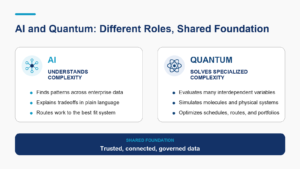
AI Orchestrates the Future of Enterprise Computing
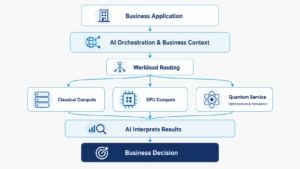
Enterprise applications already draw on a mix of computing resources, and a single workflow might touch cloud services, CPUs, GPUs, a vector database, a knowledge graph, and a foundation model without any user being aware of it. Quantum fits the same pattern, invoked when its capabilities justify the call and ignored the rest of the time, with one important difference: quantum processors can’t consume enterprise data directly. Something must prepare the problem first by gathering the relevant data, applying business context, and translating the workload into a quantum-ready representation, and that work falls to AI. The prepared problem is then handed off through APIs to a QaaS (Quantum-as-a-Service) platform, which returns classical results for AI to interpret and deliver through whatever application the user was already in.
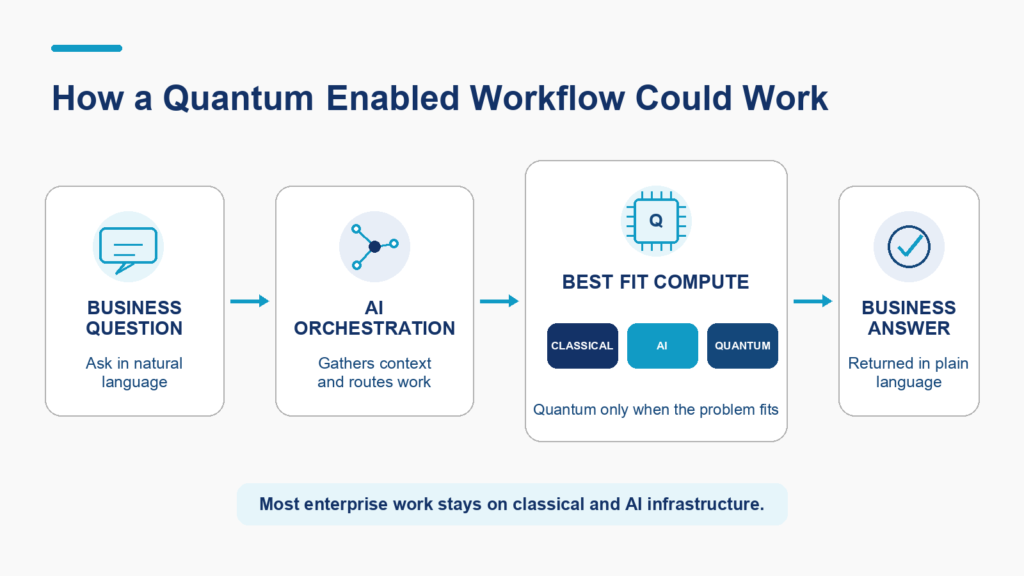
Picture a plant manager asking an AI assistant which production schedule will be most profitable next month. The assistant pulls schedules, supplier constraints, demand forecasts, maintenance windows, labor availability, and current business priorities, reasons through the operating rules, frames the optimization problem, and decides where to run each piece of it. Most of the work stays on existing infrastructure, but when the job comes down to evaluating millions of scheduling permutations under shifting constraints, a genuinely combinatorial problem, that portion goes to a QaaS platform and the results come back for the assistant to explain in plain language. The manager notices none of it and simply gets an answer to the question asked.
That’s the shape enterprise computing is taking: an orchestration layer that routes work to whichever specialized engine fits it, with LLMs as the interface, classical infrastructure carrying most of the load, and quantum services taking the narrow band of optimization and simulation problems that conventional architectures handle badly.
Quantum Readiness Is Built on Better Data
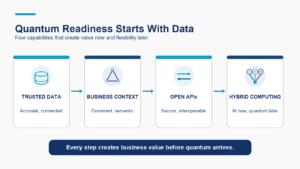
If hybrid computing is the destination, data is the road. Industry estimates suggest that roughly 80 percent of enterprise data is unstructured, spread across documents, emails, PDFs, images, and scans that traditional systems struggle to interpret. Making that information accessible, connected, governed, and semantically meaningful creates value for AI today and establishes the foundation quantum computing will require later. No amount of computational power fixes inconsistent business definitions, fragmented operational systems, duplicate records, or numbers that contradict each other, which is why preparing for quantum means largely the same work organizations are already doing to improve AI outcomes.
Quantum does add one architectural layer, in that you need the ability to translate enterprise optimization problems into quantum-ready form, route those workloads through secure APIs to a QaaS provider, and fold the results back into existing AI workflows and business applications. The full list of what that requires:
- Modern, integrated data platforms
- Data governance and stewardship with real ownership
- Semantic business models that carry business context
- Master data management
- Interoperable enterprise architecture
- API orchestration between AI platforms and QaaS providers
- Preprocessing pipelines that shape optimization workloads for quantum execution
- Consistent metadata and business definitions
Notice what’s absent from that list below the dotted line: quantum hardware, and any need to guess at a timeline. Every item improves analytics, AI performance, governance, and operational visibility on its own, so if quantum adoption arrives sooner than expected the foundation is already there, and if it takes another decade the investment has paid out several times over in the meantime. That’s the argument for treating enterprise data as a durable strategic asset rather than a project: it improves your odds with whatever comes next, whether that’s classical computing, AI, quantum systems, or something not yet built.
How MILL5 Helps Organizations Prepare for What’s Next
Preparing for quantum is an architecture problem rather than an application development project, and it starts with enterprise architecture that can absorb new computational technologies as they arrive. No organization should be redesigning workflows, rebuilding applications, and restructuring data every time a new computing capability shows up; the orchestration layer should change while business processes, integrations, data models, and user experience stay where they are.
That starts with data. MILL5 helps organizations build trusted, connected, AI-ready information environments where customers, products, assets, suppliers, processes, and operational constraints are modeled as one enterprise instead of sitting in systems that don’t talk to each other. Standardized schemas, semantic models, useful metadata, and enforceable governance let AI reason more effectively over what you already know while producing the structured inputs that advanced optimization will need later.
We also build the data bridges into your pipeline that let AI route work to the right computing resource, preparing the data, applying business context, translating the optimization problem, invoking the appropriate engine, and interpreting what comes back before delivering it through the applications your people already use. Because that orchestration runs through APIs rather than tightly coupled infrastructure, you can adopt new computational capabilities without touching your business processes.
This matters most for organizations running systems with many moving, interdependent parts, where every new constraint expands the problem space sharply: manufacturers optimizing production, logistics providers coordinating global supply chains, utilities balancing generation against demand, financial institutions managing portfolios, health systems improving care delivery, and life sciences companies compressing drug discovery timelines. These are the domains where quantum will eventually matter most, because they pair large-scale optimization with rich enterprise data, and they’re also, conveniently, the domains where better data and AI already produce measurable results. The choice was never AI or quantum but building a foundation that supports both, using AI to understand the business problem and quantum to solve the optimization work classical systems can’t process efficiently.
Technology Changes, Data Endures
The organizations that create the most long-term value are rarely the ones chasing individual technologies; they invest in the capabilities that make every technology work better, and enterprise data is one of those capabilities. Trusted, connected, governed information produces better insight and automation today while letting you adopt what’s coming without tearing out the foundations first, which is why you don’t have to wait for quantum computing to start preparing for it.
To discuss what a quantum-ready data foundation would look like for your organization, contact Ava Iannessa at avai@mill5.com.