
Key Takeaways:
- Strategy: AI has made idea generation abundant; the real advantage is identifying and framing the right business problem before investing in solutions.
- Build: Once the right problem is defined, value comes from engineering secure, scalable, production-ready AI, data, cloud, and application solutions that fit real workflows.
- Operate: Long-term AI impact depends on monitoring performance, adoption, cost, risk, and business outcomes, then continuously improving based on what the system reveals
Generative AI has changed the economics of innovation.
A few years ago, idea generation still felt like a scarce capability. Companies invested heavily in workshops, research sprints, innovation labs, and brainstorming sessions because better ideas often led to better products, better customer experiences, and better business outcomes.
Today, every executive, product team, analyst, developer, and competitor has access to tools that can generate ideas on demand. New product concepts. Market-entry options. Customer journey improvements. Automation candidates. Technical architectures. Messaging variations. The list goes on.
That does not make ideation irrelevant. It makes it insufficient.
The companies that win with AI will not be the ones that simply generate the most ideas. They will be the ones that know where to aim AI in the first place. They will identify the right problem, understand the hidden friction behind it, build solutions that solve for real operating conditions, and continuously improve those solutions once they are in production.
In other words, the durable advantage is shifting from having more ideas to framing better problems.
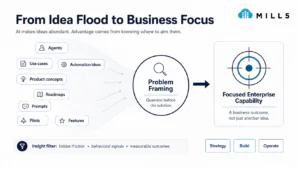
The Real AI Opportunity Starts Before the Solution
Many organizations still approach AI from the wrong starting point.
They ask:
“What chatbot should we build?”
“What processes can we automate?”
“What copilots should we deploy?”
“What use cases can we show the board?”
Those are reasonable questions, but they are not the first questions. They assume the problem is already understood. In many cases, it is not.
The better starting point is:
“What are we misunderstanding about the work?”
“Where are customers, employees, or partners creating workarounds?”
“Where do stated needs differ from actual behavior?”
“Where are our systems producing activity without producing value?”
“What problem are we solving because it is visible, not because it is most important?”
This is where AI becomes far more valuable than an idea engine. Used correctly, AI can help organizations detect patterns across messy, fragmented, and often underused sources of information: customer support logs, call transcripts, product telemetry, workflow data, service tickets, sales notes, operational dashboards, user feedback, and system events.
The insight does not come from the model alone. It comes from combining AI-enabled pattern detection with human business judgment.
AI can help surface the signal. Leaders still need to interpret what it means.
The Hidden Problem Is Usually in the Gap Between What People Say and What They Do
Customers and employees rarely describe the root cause of their frustration with precision.
A customer may say a product is “too hard to use,” when the deeper issue is that onboarding creates uncertainty at a critical moment. A field team may ask for “better reporting,” when the real issue is that five systems disagree about the same customer, asset, claim, or order. A finance team may request “more automation,” when the real problem is not manual effort itself, but lack of trust in the data that automation would depend on.
What people say matters. But what people do often matters more.
Workarounds are especially revealing. Shadow spreadsheets, duplicate data entry, manual reconciliations, offline approvals, repeated escalations, abandoned workflows, and “tribal knowledge” are not just inefficiencies. They are clues. They show where the current operating model no longer matches reality.
That is where high-value AI opportunities often emerge.
Not from asking a model for ten automation ideas, but from using AI to examine where the business is already compensating for broken processes, fragmented data, poor user experience, unclear accountability, or missing system intelligence.
The opportunity is not just to make the old process faster. The opportunity is to ask whether the old process was solving the wrong problem.
The MILL5 View: AI Advantage Requires Strategy, Build, and Operate
At MILL5, we see this as a practical enterprise challenge, not an abstract innovation exercise.
AI value becomes real when organizations can move through three connected disciplines:
- Strategy: Identify and frame the right problem.
- Build: Engineer the right solution for production.
- Operate: Run, measure, secure, and improve the solution over time.
When one of these disciplines is missing, AI initiatives stall.
A strategy without build capability becomes a roadmap that never reaches production. A build effort without strategic framing becomes a technically impressive solution to a low-value problem. An AI system without an operating model becomes a pilot that degrades, drifts, or loses business trust after launch.
The companies that create lasting AI advantage connect all three.
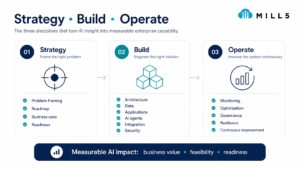
Strategy: Reframe the Problem Before You Fund the Solution
The first step is not choosing a model. It is understanding the business problem with enough clarity to know whether AI should be used at all.
A strong AI strategy begins with problem framing. That means looking beyond the obvious request and testing whether the organization is solving the right issue.
For example:
- A team asks for an AI assistant to summarize meetings. The deeper problem may be that decisions are not being captured, assigned, or followed through.
- A service organization asks for a chatbot. The deeper problem may be that customers cannot find consistent answers because internal knowledge is fragmented.
- A product team asks for better recommendations. The deeper problem may be that the company is optimizing for preference when customers are actually making decisions based on timing, urgency, risk, or confidence.
- An operations team asks for predictive analytics. The deeper problem may be that alerts are already abundant, but no one trusts which ones require action.
These distinctions matter because they change the roadmap.
The strategic question is not, “Can AI solve this?” The better question is, “What would have to be true for AI to create measurable business value here?”
That requires executive alignment, current-state assessment, data readiness evaluation, risk review, process understanding, and clear success metrics. It also requires prioritization. Not every AI opportunity deserves investment. The best opportunities sit at the intersection of business value, data availability, workflow fit, technical feasibility, and operational readiness.
This is where Strategy creates leverage. It helps organizations avoid random acts of AI and focus investment where it can change outcomes.
Build: Turn the Reframe Into a Production-Ready System
Once the right problem is framed, the work shifts from possibility to engineering.
This is where many AI programs struggle. A prototype can be created quickly. A production-grade system cannot.
Enterprise AI solutions need architecture, integration, security, data pipelines, user experience, governance, deployment automation, observability, and cost controls. They need to fit into the systems people already use and the workflows the business already depends on. They need to be tested not only for whether the model responds, but whether the solution improves the process.
The Build phase is where the organization makes the insight executable.
That may mean developing an AI-enabled application, embedding intelligence into an existing platform, modernizing the data layer, building an agentic workflow, integrating with enterprise systems, or creating a secure cloud foundation that can support scale.
The key is to build for the actual problem, not the initial assumption.
- If the problem is trust, the solution may need transparent source attribution, auditability, and human review.
- If the problem is speed, the solution may need workflow automation and real-time integration.
- If the problem is inconsistency, the solution may need data standardization and business rule alignment.
- If the problem is adoption, the solution may need better experience design rather than more model capability.
AI does not eliminate the need for strong engineering. It increases it.
The more powerful the technology becomes, the more important it is to build systems that are secure, reliable, measurable, and aligned to how the business actually operates.
Operate: The Advantage Compounds After Launch
The launch of an AI solution is not the end of the work. It is the beginning of the learning cycle.
AI systems operate in dynamic environments. Data changes. User behavior changes. Business priorities change. Models improve. Regulations evolve. Costs fluctuate. Security requirements tighten. What worked in the pilot may need adjustment in production.
That is why Operate motion is essential.
Organizations need to monitor more than uptime. They need to monitor business outcomes, adoption, response quality, model performance, workflow effectiveness, cost, latency, security events, user feedback, and process impact. They need clear ownership for ongoing improvement. They need feedback loops that turn operational data into the next round of strategic insight.
This is where AI can become a continuous advantage.
A well-operated AI system does not simply execute a task. It generates signals about where the business is working, where it is struggling, and where the next improvement should occur.
That creates a loop:
- Observe behavior.
- Surface patterns.
- Reframe the problem.
- Build the right solution.
- Operate and measure it.
- Use what you learn to improve again.
This loop is how AI moves from experimentation to enterprise capability.
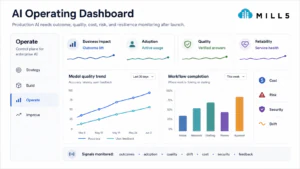
The Executive Imperative
For leaders, the message is clear: AI is making ideas abundant, but insight remains scarce.
The next wave of advantage will not come from asking AI for more suggestions. It will come from using AI to better understand customers, employees, processes, systems, and operational friction. It will come from seeing the problem differently before competitors do. And it will come from having the engineering and operating discipline to turn that insight into a reliable business capability.
Executives should be asking their teams:
- Are we solving the most visible problem or the most valuable one?
- Where are people creating workarounds our systems do not acknowledge?
- What behavioral data are we not using today?
- Which AI initiatives are tied to measurable business outcomes?
- Do we have the architecture, security, governance, and operating model to scale what we build?
- How will we learn from the system once it is live?
These questions are not academic. They determine whether AI becomes a collection of pilots or a source of competitive advantage.
The Bottom Line
Generative AI can help create ideas, but ideas are no longer the constraint. The constraint is knowing which problems are worth solving, building the systems that solve them, and operating those systems in a way that compounds value over time.
That is the real AI advantage: Not more ideas. Better framing. Better execution. Better operations. And for organizations ready to move from AI experimentation to measurable impact, that is exactly where Strategy, Build, and Operate must come together. Connect with the MILL5 team via ai@mill5.com.
Frequently Asked Questions About AI Problem Framing
What is AI problem framing, and why does it matter?
AI problem framing means identifying and defining the right business problem before choosing an artificial intelligence (AI) solution. MILL5 argues that because generative AI makes ideas easy to produce, the advantage now lies in knowing where to aim AI. Instead of starting with “What chatbot should we build?”, MILL5 recommends asking, “What would have to be true for AI to create measurable business value here?” Framing the problem first establishes the business need and how success will be measured. It can also show when AI isn’t the right solution at all.
How can companies find high-value AI opportunities?
Companies can find high-value artificial intelligence (AI) opportunities by combining interviews with observation and evidence from their workflows. Workarounds such as shadow spreadsheets, duplicate data entry, manual reconciliations, offline approvals and repeated escalations can point to places where the current process no longer fits the work. These signals are worth investigating, but they aren’t automatic opportunities, and some workarounds are intentional and effective. Teams should examine how often each pattern occurs, what impact it has and what’s causing it. AI can help detect patterns across support logs, call transcripts and service tickets, but leaders still need to interpret what they mean.
What does it mean to reframe an AI request?
Reframing means looking past an initial artificial intelligence (AI) request to the problem underneath it. A team asking for an AI meeting summarizer may not need better summaries. Its real problem may be that decisions aren’t recorded, assigned or followed through, so the solution should focus on who owns each decision. Similarly, an operations team asking for predictive analytics may already have plenty of alerts but little confidence in which ones need action. There, the answer may be making alerts more trustworthy, with clear sources and human review, rather than adding more predictions.
How should organizations decide which AI opportunities to fund?
Organizations should compare artificial intelligence (AI) opportunities across five criteria from MILL5’s Strategy approach: business value, data availability, fit with existing workflows, technical feasibility and operational readiness. The strongest candidates do well on all five. Making that call requires alignment among the relevant business owner, the technical team and decision-makers. It also requires an assessment of current processes and how ready the data is, a risk review, and success metrics defined in advance. MILL5’s AI strategy services help organizations prioritize this way, so investment goes where AI can change outcomes.
How do strategy, delivery and operations work together to sustain AI value?
MILL5 highlights three gaps that can keep artificial intelligence (AI) initiatives from delivering lasting value. A strategy without the ability to build can produce a roadmap that never reaches production. Building without strategic framing can produce an impressive solution to a low-value problem. And an AI system without an operating model can degrade, drift or lose the business’s trust after launch. MILL5’s Strategy, Build and Operate framework connects all three. In the Operate phase, MILL5’s managed services teams monitor outcomes, adoption, quality and cost, then use what they learn to reframe the next problem.