Millie Summary
- If your organization has invested in dashboards, ERP systems, supplier portals, or analytics tools but still struggles to turn operational data into timely action, this article explains why visibility is no longer enough.
- Explore how digital twins, RFID, sensors, cold-chain capabilities, planning systems, AI, and IoT can work together as part of a connected industrial operating model.
- Learn why the real value is not in adopting more tools, but in building the right architecture to connect data, systems, assets, and workflows across the enterprise.
- Through examples from MILL5’s work across manufacturing, utilities, retail, healthcare, and industrial environments, learn how connected intelligence can improve efficiency, reduce risk, strengthen resilience, and create new business value.
Supply chain and manufacturing leaders have spent years investing in visibility. Dashboards, tracking systems, ERP upgrades, supplier portals, warehouse tools, and analytics platforms have all helped organizations see more of what is happening across the enterprise.
But visibility is no longer enough.
The next competitive advantage is orchestration: the ability to connect physical operations, enterprise systems, supplier networks, machine data, AI models, and frontline workflows into one decision-making fabric.
A recent Industry Dive reference on food manufacturing captured this shift well. It identified scenario planning, visibility, and traceability as foundational capabilities for food supply chains, and highlighted four technology categories gaining momentum in inventory and demand planning: digital twins, RFID and sensors, cold-chain capabilities, and stronger planning systems.
At MILL5, we see these tools as part of a much larger transformation. They are not isolated technology investments. They are building blocks of a modern industrial operating model—one where leaders can simulate disruption, monitor assets in real time, predict risk, optimize inventory, protect quality, and act faster across the value chain.
The Executive Challenge: Turning Operational Data Into Action
For CXOs, the strategic question is not, “Should we invest in AI, IoT, digital twins, or planning tools?”
The better question is: How do we build a connected architecture that allows those tools to produce measurable business outcomes?
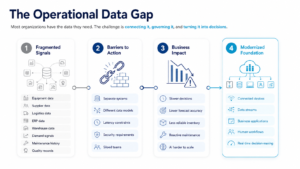
That distinction matters because many organizations already have the raw ingredients. They have equipment data, supplier data, logistics data, ERP data, warehouse data, demand signals, maintenance history, quality records, and customer commitments. The issue is that these signals often live in separate systems, governed by separate teams, with different data models, latency constraints, and security requirements.
That fragmentation slows decision-making. It limits forecast accuracy. It makes inventory less reliable. It causes teams to react to equipment failures instead of preventing them. It also makes AI initiatives harder to scale because the models are only as good as the operational data beneath them.
Our work across manufacturing, industrials, logistics, utilities, retail, and healthcare has shown us that the organizations creating the most value are not simply adopting new tools. They are modernizing the technology foundation beneath their operations.
That means connecting devices, platforms, data streams, business applications, and human workflows so that decisions can move closer to real time.
Digital Twins: From Static Planning to Live Scenario Modeling
Digital twins are becoming essential because they give leaders a way to model complexity before it becomes a crisis. In the attached reference, digital twins are described as a way to simulate the end-to-end supply chain network, analyze disruptions in real time, and help organizations adapt to changing conditions.
That has major implications for supply chain, manufacturing, and industrial operations.
A practical digital twin can help answer questions such as:
What happens if a supplier misses a delivery window? What happens if demand spikes in one region and drops in another? What happens if a production line goes down? What happens if a cold-chain asset begins drifting outside acceptable thresholds? What happens if a logistics route becomes constrained? What happens if inventory is available, but not in the right location or condition?
The power of a digital twin is not the visualization. The value comes from the underlying architecture: live data ingestion, reliable models, integration with enterprise systems, and workflows that allow planners, operators, and executives to act.
That is why our manufacturing and industrial work focuses on cloud-native platforms, IoT-enabled systems, AI-driven insights, predictive analytics, digital twins, and real-time decision-making across the factory floor and supply chain.
A digital twin becomes valuable when it is connected to the systems that run the business.
RFID and Sensors: Establishing the Physical Truth
RFID and sensors create the bridge between the physical world and the digital enterprise. The attached reference highlights their value in helping manufacturers understand available stock, locate inventory, track shelf-life status, and make faster routing decisions for products that may be nearing expiration.
That same principle applies far beyond food manufacturing.
In industrial environments, RFID, IoT, and sensor telemetry can help organizations understand the real-time state of assets, parts, tools, vehicles, equipment, facilities, inventory, containers, field infrastructure, and production environments. But collecting telemetry is only the first step.
The real work is turning those signals into governed, secure, actionable intelligence.
That requires device identity, edge processing, cloud ingestion, event streaming, data quality, security controls, analytics, APIs, and integration into the systems where decisions are made. Those systems may include ERP, MES, WMS, TMS, CMMS, supplier portals, field-service platforms, quality systems, or executive dashboards.
Our work with a utilities technology company is a strong example of this pattern. We partnered with this company to apply AI and machine learning to sensor-driven water infrastructure, enabling predictive maintenance, proactive service operations, and smarter field-technician scheduling. The solution analyzed real-time and historical sensor data, detected early indicators of wear and pressure anomalies, anticipated equipment failures, and dynamically assigned technicians based on severity, availability, and geography.
That is the shift leaders should be looking for: not more sensor data, but fewer blind spots and faster intervention.
Cold Chain: Treating Quality as a Connected Control System
Cold chain is often discussed as a logistics issue. We view it as a connected quality, risk, and operations problem.
The attached reference notes that cold-chain investments can help maintain and extend shelf life and product quality, particularly for fresh produce, protein, and other sensitive goods. It also highlights the role of cold-chain capabilities in safely transporting and storing those products.
For executives, the broader lesson is that product quality increasingly depends on connected systems.
Cold chain operations require visibility into temperature, humidity, location, door events, dwell time, asset performance, route status, and exception history. But the business outcome is not the alert itself. The outcome is the ability to intervene before value is lost.
A mature cold chain platform should help teams determine whether a product is still viable, whether a shipment should be rerouted, whether a refrigeration asset requires service, whether inventory should be prioritized by risk, and whether a quality event should trigger downstream actions.
The architecture behind that is familiar to us: IoT telemetry, edge/cloud processing, real-time data pipelines, AI-driven risk scoring, operational dashboards, mobile workflows, and integration into planning and service systems.
Our work with a manufacturing OEM demonstrates how these capabilities come together in an industrial context. We helped perform a comprehensive architecture review of this company’s existing SCADA platform, supported the move toward Industrial IoT and edge-enabled capabilities, built IoT gateways and Azure IoT-native devices, and developed a SaaS-based fleet-management monitoring solution that created an additional revenue stream.
While the use case differs from food cold chain, the architecture pattern is highly relevant: connect the asset, secure the data, modernize the platform, enable monitoring, and create new business value from operational intelligence.
Planning Systems: Stronger Decisions Require Stronger Data Foundations
The fourth category in the attached reference is stronger planning systems. The article points to the need for more robust planning layers that help manufacturers manage inventory decisions in real time.
This is where many transformation efforts stall.
Planning systems cannot produce reliable decisions if they are built on fragmented, stale, or inconsistent data. Demand planning requires more than order history. It needs promotion data, customer signals, production constraints, supplier capacity, logistics status, inventory accuracy, shelf-life data, substitutions, and exception handling.
Inventory optimization requires more than a spreadsheet view of stock. It needs item-level, lot-level, location-level, quality-level, and time-sensitive context.
Production planning requires more than capacity assumptions. It needs current line performance, labor availability, maintenance risk, quality trends, supplier constraints, and material readiness.
In other words, planning modernization is not just a software implementation. It is a data, integration, architecture, and operating-model initiative.
Our work with Wayfair illustrates the importance of resilient integration and high-performance platform engineering. We partnered with Wayfair across supplier integration, pricing workflows, cloud migration to Google Cloud Platform, scalable microservice APIs, DevSecOps pipelines, monitoring, caching, and peak-demand reliability. The work enabled more than 50,000 requests per second on a single server and supported Wayfair’s first downtime-free cyber holiday.
For supply chain leaders, that matters because modern planning depends on the same core capabilities: scalable APIs, reliable integrations, cloud-native infrastructure, observability, automation, and systems that can perform under real business pressure.
What We Build: The Industrial Intelligence Layer
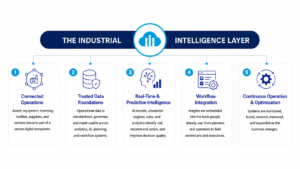
The companies that win will not simply deploy digital twins, RFID, cold-chain tools, and planning systems as separate initiatives. They will connect them into an industrial intelligence layer.
That layer includes five core capabilities.
- First, connected operations: assets, equipment, inventory, facilities, suppliers, and workers become part of a secure digital ecosystem.
- Second, trusted data foundations: operational data is standardized, governed, and made usable across analytics, AI, planning, and workflow systems.
- Third, real-time and predictive intelligence: AI models, simulation engines, rules, and analytics identify risk, recommend action, and improve decision quality.
- Fourth, workflow integration: insights are embedded into the tools people already use, from planners and operators to field technicians and executives.
- Fifth, continuous operation and optimization: systems are monitored, tuned, secured, improved, and expanded as the business changes.
This is where our Strategy, Build, and Operate model becomes important.
In the Strategy phase, we help organizations define the use cases that matter most, quantify the business value, assess the current-state architecture, evaluate data readiness, and build a roadmap that connects technology investment to operational outcomes.
In the Build phase, we design and implement the platforms, applications, IoT systems, APIs, AI models, cloud infrastructure, data pipelines, dashboards, and workflows required to move from concept to production.
In the Operate phase, we help keep those systems reliable, secure, cost-effective, and continuously improving.
For industrial leaders, this lifecycle matters because these systems are not static. Supplier networks change. Demand shifts. Equipment ages. Data drifts. Models need retraining. Security requirements evolve. Business users discover new workflows. The architecture must be designed for change from the beginning.
Lessons From Our Work Across Complex Operational Environments
Our client work reinforces a consistent theme: value comes from connecting intelligence to action.
With the manufacturing OEM, we helped modernize an industrial platform from legacy SCADA toward cloud-based IIoT, edge-enabled device connectivity, SaaS fleet management, and improved monitoring and maintenance.
With a utilities technology company, we used AI and machine learning to analyze sensor-driven infrastructure data, predict failures, reduce disruption, and improve field-service scheduling.
With Wayfair, we modernized supplier-facing systems, high-performance APIs, pricing workflows, cloud infrastructure, and peak-event reliability.
With Olympus, we applied AI, machine learning, Azure, edge computing, and secure hybrid cloud architecture to smart operating-room environments, reducing operating-room turnover time by 30% and delivering analytics integrated with Olympus smart-OR products.
These are different industries, but the pattern is the same: connect operational data, modernize the platform, apply intelligence, embed the insight into workflow, and create measurable business outcomes.
The CXO Takeaway
Digital twins, RFID, sensors, cold chain systems, and planning platforms are not simply technology trends. They are signals of a larger shift in how modern enterprises operate.
The future of supply chain, manufacturing, and industrial performance will be defined by the ability to sense what is happening, understand what it means, simulate what could happen next, and act quickly enough to change the outcome.
That requires more than software selection. It requires architecture. It requires integration. It requires trusted data. It requires AI that can run in production. It requires cloud and edge systems designed for operational realities. It requires security, governance, and managed operations.
Most importantly, it requires a partner that can move across the full stack—from strategy to implementation to long-term operation.
At MILL5, this is the work we do every day. We help organizations turn complex operational environments into intelligent, connected systems that improve efficiency, reduce risk, strengthen resilience, and create new opportunities for growth. For more information, email Jordyn Geiger, Growth Development Analyst, at jordyng@mill5.com.