
Key Takeaways:
- CPUs, specialized AI accelerators, NPUs, and FPGAs can offer cost-effective alternatives to GPUs for certain inference workloads. The best choice depends on the application’s requirements and expected demand.
- As AI applications move into production, inference becomes a recurring operating expense. Choosing hardware that matches actual demand can reduce unnecessary spending and limit dependence on specialized infrastructure.
- Organizations should benchmark GPU alternatives using realistic workloads and evaluate the total cost of ownership before making infrastructure investments. The decision should reflect how the application will perform and what it will cost to operate over time.
Written by Ava Iannessa, Growth Development Analyst
Why Are Organizations Considering Alternatives to GPUs?
Uncertainty surrounding NVIDIA’s leadership and outlook has unsettled investors, adding to broader concerns about the sustainability of AI infrastructure spending. For technology leaders, the attention surrounding NVIDIA raises a practical question about whether the hardware powering their AI investments remains the most appropriate choice as applications move into production.
GPUs have become central to AI development because they can perform large volumes of calculations simultaneously, making them particularly effective for training complex models. Inference, the process of using a trained model to generate a prediction or response, places different demands on computing infrastructure. Depending on the model and how it is used, inference may require considerably less processing power than training.
That distinction becomes increasingly important as AI applications begin serving users continuously. Infrastructure that made sense during development may become unnecessarily expensive when inference turns into a recurring operating expense. As organizations look more closely at the economics of AI, the question becomes whether other hardware architectures can deliver the required performance at a lower cost.
For many workloads, the answer is yes. CPUs, specialized AI accelerators, neural processing units (NPUs), and field-programmable gate arrays (FPGAs) can all support AI inference, depending on the application. Understanding where these alternatives perform well gives organizations an opportunity to reduce unnecessary spending while maintaining greater flexibility as their AI requirements evolve.
CPUs for Smaller Models and Moderate Demand
Central processing units (CPUs) are among the most accessible alternatives to GPUs because they already support much of today’s enterprise infrastructure. Advances in inference software have expanded the range of AI models that can run effectively on general-purpose processors, making CPUs worth considering before investing in dedicated acceleration.
For smaller models and applications with moderate processing requirements, existing CPU infrastructure may already provide sufficient capacity. Document classification and predictive analytics are examples of workloads that can often run without specialized hardware. Even certain language-model applications can perform adequately on CPUs, particularly when techniques such as quantization are used to reduce memory requirements.
There is also an operational advantage to working with familiar infrastructure. Teams can often plug into established deployment, security, and monitoring practices, reducing the effort required to introduce AI into an existing environment. For applications with limited traffic, that simplicity can be more valuable than the additional processing capacity of a GPU.
The limitations become more apparent as models grow and request volumes increase. CPUs have less parallel processing capacity than GPUs, and memory bandwidth can become a constraint when multiple requests must be handled simultaneously. An application that responds quickly during initial testing may struggle to maintain that performance under heavier demand.
Organizations should evaluate how their models perform on CPUs under realistic traffic conditions and compare the results against their service requirements. Where CPUs can deliver acceptable performance at a lower total cost, dedicated acceleration may add expense without providing a meaningful business benefit.
Purpose-Built Accelerators for Sustained Inference
As inference workloads grow, specialized AI accelerators offer another way to improve computing efficiency. These processors are designed around the mathematical operations used by neural networks, allowing them to dedicate more of their architecture to the work required to execute AI models.
Google’s Tensor Processing Units (TPUs) and AWS Inferentia are examples of purpose-built processors available through cloud platforms. Both offer alternatives to GPUs for compatible models, with architectures designed to improve the efficiency of machine learning workloads.
Their potential value becomes more apparent when applications process large volumes of requests on a consistent basis. For an organization operating a customer-facing AI service, even a modest reduction in the cost of each inference can accumulate into meaningful savings.
However, the transition requires careful consideration. Models may need to be compiled or adapted for a particular processor, and compatibility can vary depending on the AI framework and serving environment. An application that runs successfully on a GPU may require additional engineering before it can operate efficiently on a different architecture.
Lower processing costs may be offset by the effort required to migrate an application, particularly when models are updated frequently or the organization lacks experience with the target platform. Cloud-specific processors can also introduce dependencies on a provider’s infrastructure and development tools.
For organizations with substantial inference demand, those tradeoffs may be worthwhile. The decision should follow a technical evaluation that confirms model compatibility and measures performance under production-like conditions. That provides a more reliable indication of whether specialized acceleration will reduce costs over the application’s lifetime.
NPUs for Inference on Devices
Neural processing units (NPUs) offer a different approach by allowing supported AI models to run directly on devices. These specialized processors are increasingly incorporated into laptops and embedded systems, where they can execute inference without relying on a continuous connection to centralized cloud infrastructure.
This is particularly relevant for applications where responsiveness and connectivity affect how the system operates. Consider a medical device that continuously analyzes sensor readings to identify abnormal conditions. Processing suitable workloads locally allows the device to respond without waiting for information to travel to a remote server and back.
Of course, local processing introduces its own constraints. Devices have limited memory and power capacity, which can restrict the complexity of the models they support. Performance can also vary across hardware generations, creating challenges when an application must operate consistently across different devices.
Managing those deployments requires ongoing attention as well. Models still need to be distributed, updated, and monitored, even when they execute independently of the cloud. For organizations operating large fleets of connected devices, maintaining that consistency becomes an important part of the infrastructure decision.
NPUs are therefore most compelling when local inference addresses a specific operational requirement. Their value depends on whether the benefits of processing information closer to its source outweigh the additional complexity of managing AI across distributed hardware.
FPGAs for Specialized Inference Applications
Field-programmable gate arrays (FPGAs) provide another alternative for applications with highly specific computing requirements. Unlike conventional processors, FPGAs can be reconfigured to execute particular operations, allowing engineers to tailor processing behavior to the needs of an application.
This flexibility can be valuable when inference must operate within strict timing or power constraints. For example, a manufacturer using computer vision to inspect products on an assembly line may need to analyze images within a fixed time window. An FPGA can be configured to accelerate the relevant processing operations, helping the inspection system maintain consistent response times without interrupting production.
Similar requirements arise in telecommunications and embedded systems, where AI inference may need to operate alongside other hardware processes. In these environments, the ability to customize execution can provide advantages that general-purpose infrastructure may struggle to match economically.
The tradeoff is the engineering effort involved. Developing FPGA-based applications requires specialized expertise, and changes to an AI model may also require adjustments to the underlying processing pipeline. That can make ongoing maintenance more demanding, particularly for organizations whose models or application requirements change frequently.
For most enterprise applications, FPGAs will remain a targeted option. They are most appropriate when a clearly defined operating requirement justifies the additional development effort and the organization can support the solution over time.
How Do GPU Alternatives Compare?
The differences between these architectures become clearer when considered in the context of how an application will operate. A smaller model serving a limited number of requests has very different infrastructure requirements from a large language model supporting thousands of simultaneous users. Similarly, an application running on a medical device faces constraints that may be irrelevant to a cloud-hosted service.
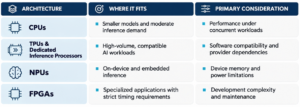
Independent benchmarks, such as MLCommons’ MLPerf Inference, offer a useful reference for comparing performance across computing architectures. These results can help organizations identify promising options, although they cannot determine which processor will be most economical for a particular application.
Actual performance depends on how the model behaves under production demand. A processor that performs well in standardized testing may deliver different results once integrated with an application’s existing software and infrastructure. This is why evaluating alternatives against representative workloads is so important.
The financial comparison also needs to extend beyond the cost of the hardware itself. Moving to a different architecture can introduce engineering work and ongoing support requirements that affect the total cost of ownership. An alternative processor may offer lower inference costs while requiring enough additional maintenance to reduce or eliminate the expected savings.
For technology leaders, the objective is to establish which architecture can reliably meet the application’s requirements at a sustainable cost. That decision becomes more defensible when it is supported by testing rather than assumptions about which processor should perform best.
Building Flexibility Into AI Infrastructure
The uncertainty surrounding NVIDIA has brought renewed attention to the economics of AI computing. As inference becomes a larger part of enterprise technology spending, organizations have an opportunity to reassess whether their existing infrastructure remains appropriate for the applications they support.
At MILL5, we help organizations make these decisions through our Strategy → Build → Operate framework, connecting infrastructure evaluation with the engineering and ongoing support needed to sustain AI applications in production.
We begin by understanding what the application needs to deliver and how much its current infrastructure costs to operate. With those requirements established, we evaluate suitable deployment alternatives using representative workloads and expected demand.
This allows us to compare performance and total operating costs while accounting for the engineering effort involved in moving to a different platform. The result is a clearer understanding of where alternative hardware can provide value and whether the investment is justified.
Once the appropriate architecture has been identified, we adapt the model-serving environment and integrate it with existing applications. Automated testing helps confirm that the deployment meets its performance requirements before it reaches production.
We also establish repeatable deployment processes that allow teams to introduce model updates and infrastructure changes with confidence. This gives organizations a more reliable way to maintain their applications as requirements evolve.
We provide 24/7 monitoring and incident response to help organizations maintain performance as inference demand changes. Our teams track infrastructure consumption and investigate performance issues, helping identify where resources can be used more efficiently.
Through tools such as MILL5’s Azure Best Practices Analyzer, we also help organizations identify underutilized resources and opportunities to optimize cloud and AI consumption costs. This provides greater visibility into operating expenses as applications scale.
For a complimentary strategy session to discuss your AI infrastructure priorities, contact Ava Iannessa and the MILL5 team at avai@mill5.com.
Frequently Asked Questions About GPU Alternatives for AI Inference
Can AI Inference Run Without a GPU?
Yes. Many AI models can run on CPUs or specialized processors without requiring a GPU. Smaller language models and conventional machine learning applications may perform adequately on general-purpose infrastructure, particularly when optimized for efficient execution. The determining factor is whether the selected hardware can meet the application’s performance requirements under realistic demand.
When Should an Organization Consider Specialized AI Accelerators?
Specialized AI accelerators are worth evaluating when inference becomes a substantial and predictable operating expense. Processors designed for neural network execution may improve efficiency for compatible models, particularly at higher request volumes. However, organizations should confirm that their models are supported and that the expected savings justify the engineering work required to move to a different architecture.
What Are the Risks of Moving AI Inference Away From GPUs?
Moving inference to another architecture can introduce compatibility issues and additional engineering requirements. Some processors require models to be compiled or adapted, while others impose restrictions on supported operations. Organizations may also become more dependent on a particular cloud provider or hardware ecosystem. Testing representative workloads before migration helps identify these risks and establish whether the expected benefits are achievable.
When Should an Organization Seek Outside Help Evaluating AI Infrastructure?
Outside expertise can be useful when an organization is planning a major inference deployment, experiencing rising AI operating costs, or considering a move to specialized hardware. These decisions often require coordinated work across AI engineering and infrastructure operations. MILL5 helps organizations evaluate suitable architectures, implement the selected approach, and establish the practices needed to maintain performance and control costs over time. MILL5’s Strategy, Build, and Operate services connect infrastructure decisions with production engineering and ongoing cost management.