
Key Takeaways:
- Most AI business cases overstate return because they count activity, such as hours saved, as value and price only the visible bill for licenses and tokens.
- In an illustrative case, a projected 500% return falls to about 43% once benefits are weighted for adoption and technical risk and the full lifecycle cost is counted. That is a different funding decision and deserves a different level of executive attention.
- Fund AI on risk-adjusted value, and classify every projected benefit by how it reaches the financial statements before the initiative is approved.
Written by Jordyn Geiger, Growth Development Analyst
Part 2 of a six-part MILL5 series on converting AI and technology spend into enterprise value. Previously: Part 1, “The AI Capital-Efficiency Gap.”
Most AI business cases overstate return because they measure the wrong numerator and the wrong denominator. The numerator is usually activity, such as seats activated, prompts submitted, or hours saved. The denominator is usually the visible bill for licenses, tokens, and a cloud estimate. Divide one by the other, and almost any initiative clears the hurdle rate, which is how organizations end up with many approved pilots and very little in the P&L.
A decision-grade business case works differently. It weighs each benefit by the probability that it materializes, charges the full cost of delivering it, and counts only the benefits finance can see in the financial statements. In Part 1, we showed AI spending compounding while reported earnings impact stays flat. Weak business-case arithmetic is the most immediate cause.
Practitioners responsible for the numbers already see the problem. The FinOps Foundation’s State of FinOps 2026 lists determining AI value and ROI among the top AI challenges its respondents face, alongside visibility into AI costs and allocating those costs to business units. Cost and value are the two inputs to any ROI calculation. When both are uncertain, the result is an estimate presented as a return.
Why Does Conventional ROI Flatter AI?
Conventional ROI assumes that benefits are certain and costs are known, and AI offers neither. The standard formula is simple.
ROI = (Total benefit − Total cost) ÷ Total cost
Benefits from AI depend on whether people use the system, whether it performs in production, and whether management converts the result into cash. Costs grow after launch as review labor, monitoring, and consumption pricing arrive. The conventional formula treats all of this as settled at the moment of approval.
Risk-adjusted ROI is a return measure that weighs each benefit by the probability it materializes and charges the full cost of delivering it.
Risk-adjusted AI value = Σ over each year t of [Expected benefit(t) × P(adoption) × P(technical success) − Full lifecycle cost(t)] ÷ (1 + r)^t
Risk-adjusted ROI = Risk-adjusted AI value ÷ Present value of full lifecycle cost
Here ‘r’ is the discount rate. ‘P(adoption)’ is the probability that usage reaches the level the business case assumes, and ‘P(technical success)’ is the probability that the system meets its quality threshold in production. Both should be estimated from evidence such as pilot telemetry, comparable deployments, and validation results. A number agreed in a planning workshop is an assumption, and it should be labeled as one.
A MILL5 Client Success Story
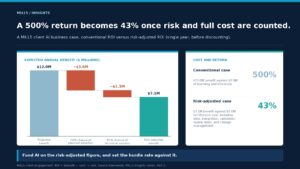
A MILL5 client projects $12M of annual benefit against $2M of licensing and inference cost, a conventional ROI of 500%. There is a 70% probability of reaching planned adoption and an 85% probability of meeting the production quality threshold. Once data, integration, validation, review labor, and change management are included, the full lifecycle cost is $5M. Expected benefit falls to about $7.1M, and the single-year return before discounting falls to roughly 43%. A risk-adjusted return this far below the headline figure does not necessarily rule out funding, but it means leadership is making a much narrower bet than the original case suggested.
What Belongs in the Full Lifecycle Cost of AI?
The vendor invoice is often the smallest material line in an AI cost base. The technology itself covers software licenses, APIs, tokens, inference, training, and cloud infrastructure. Around it sits the costs of acquiring, preparing, labeling, storing, and governing data, along with the internal time of engineering, product, risk, legal, and business teams. Systems integration and the workflow redesign needed to use the output belong here too.
A second group of costs is easier to miss because it arrives after go-live. Model validation, monitoring, red teaming, and security review continue for as long as the system runs, as do vendor management and third-party assurance. Training and change management determine whether adoption happens at all. Exit costs, including migration, parallel operation, termination, and decommissioning, should be priced on day one.
Two of these lines deserve particular scrutiny. If every output must be checked by a person, incremental review labor can absorb much of the saving the system was meant to create. Exit cost matters just as much. Gartner’s 2026 AI spending forecast observes that the risks of vendor lock-in, data sovereignty, and runaway costs are not deterring buyers from adopting proprietary AI capabilities embedded in incumbent software. Unpriced risks still arrive, usually at renewal.
Which AI Benefits Actually Reach EBITDA?
Only realized cash savings reliably improve EBITDA directly. A single “benefit” figure in an AI business case can mean seven different things, and each one is treated differently in the financials. The table below sets out how each category should be handled.
| Benefit category | Example | Financial treatment |
| Realized cash savings | Lower vendor fees, fewer contractors, retired licenses | Improves EBITDA and cash flow directly |
| Released capacity | Employee hours saved | Reaches EBITDA only if the capacity is removed, redeployed, or used to produce more output |
| Cost avoidance | A hire or infrastructure expansion that is no longer needed | Real value, but never reported as savings already in hand |
| Revenue contribution | Higher conversion, retention, price, or volume | Counted as incremental gross profit rather than gross revenue |
| Loss avoidance | Fewer fraud losses, errors, incidents, or credit losses | Credible only against a defensible baseline and a probability estimate |
| Working-capital improvement | Faster collections or lower inventory | May improve cash flow without moving EBITDA |
| Strategic option value | Faster launches or entry into a new market | Potentially important, and far less certain than realized cash flow |
Blending these categories into one figure, and then describing it as savings, is the most common way AI cases overstate value. Each category should be forecast and reported on its own. Only measured results should be described as realized.
The Benefit-Capture Gap
The benefit-capture gap is the difference between the capacity an AI system releases and the cash the organization actually captures. Capacity is the largest benefit category in most AI cases, and it is also the one least likely to reach EBITDA. It becomes cash only through a management decision, such as reducing overtime, contractors, or headcount, deferring planned hires, absorbing more volume at the same cost, or moving people into work with a measurable return. Without one of those decisions, the organization has more slack and the same expense base.
Industry research reveals a striking disconnect: 32% of organizations anticipated AI-driven workforce reductions, yet subsequent research found only 14% reporting actual AI-related headcount declines, with nearly two-thirds experiencing little or no employment impact.
At MILL5, our experience points to a more consequential dynamic: automating work and monetizing that automation are two fundamentally different things. AI can eliminate hours of effort without removing a single dollar from the cost structure. Why? Because the bottleneck often moves rather than disappears. Faster engineering creates pressure on testing and validation. Automated customer service exposes inefficient escalation processes. Accelerated analytics produces more insights than existing decision-making structures can absorb.
We call this the AI Value-Capture Gap: the difference between productivity gained and economic value realized. The real opportunity isn’t simply reducing headcount. It’s redesigning how work flows through the enterprise so that reclaimed capacity translates into greater throughput, shorter delivery cycles, lower cost-to-serve, and measurable EBITDA improvement.
What MILL5 Sees in AI Business Case Reviews
Across MILL5’s AI assessments and delivery engagements, we consistently see organizations with meaningful AI activity, but limited evidence connecting that activity to measurable financial outcomes. Teams may be using copilots, testing automation, or exploring agent-based workflows, yet adoption, governance, cost visibility, and value measurement often vary considerably across business units. In a recent assessment for a medtech company, AI experimentation was underway across several teams, but cost and ROI tracking remained limited or inconsistent, while most usage was still concentrated in chat-based tools rather than integrated workflows.
Emerson shows why benefit categories should be reported separately. MILL5 moved Emerson’s legacy SCADA platform to a cloud-based Industrial Internet of Things (IIoT) platform that now connects more than 10,000 devices. The Emerson case study, the work produced $1 million in operating cost savings, and the predictive maintenance feature in the new fleet management solution created a new revenue stream. Those are two different benefits with different financial treatment. The cost savings reach EBITDA directly, while the new revenue should be measured as incremental gross profit as it grows.
The lesson is that a promising use case is not yet an investable business case. Before scaling, organizations need a finance-approved baseline, a named owner for capturing the benefit, and production measures that distinguish activity from realized value. MILL5 has seen the strongest outcomes when financial measures are designed into the solution from the beginning, alongside the architecture, governance, adoption plan, and operating model. That approach turns AI from a collection of experiments into a managed portfolio in which leaders can decide what to scale, redesign, consolidate, or stop.
How MILL5 Approaches AI Business Cases
Strategy Underwrites AI Like an Investment
Risk-adjusted value should be the funding metric, and every case should state its adoption and technical-success estimates along with the evidence behind them. Before approval, each projected benefit should be placed in one of the seven categories. A named executive should be accountable for turning released capacity into cash. The hurdle rate and the stop threshold should apply to the adjusted figure rather than the headline one.
Build Costs It Fully and Designs for Capture
The cost model should be built from the full lifecycle list, including review labor and exit cost, and refreshed at every stage gate. Capacity capture belongs in the design itself, which means deciding which roles change and which hires are deferred before the system goes live. Baseline and post-launch measures should be built into the system, so benefits are measured rather than surveyed.
Operate Reports What Finance Can See
Realized benefits should be tracked monthly against the pre-launch baseline, by category, with finance signing off. FinOps unit economics, such as cost per completed task and cost per decision, will catch consumption drift before it erodes the case. Initiatives whose adjusted return stays below threshold should be restructured or retired, and their budget redeployed.
What Leaders Should Ask Before the Next Funding Round
Start by asking which AI business cases still rely on conventional ROI and how they look on a risk-adjusted basis. Then ask what adoption and technical-success probabilities are being assumed and what evidence supports them. Leaders should also know how much of the projected benefit is capacity rather than cash, and who owns converting it.
Then test the cost side and the reporting. Is human review labor in the cost base, and how was it estimated? Are cost avoidance or gross revenue being reported as if they were realized savings? Finally, ask which initiative would be stopped today if it were charged its full lifecycle cost.
Bottom Line
Usage shows that a tool is being used. It says nothing about whether the investment was worth making. A business case that weights benefits by probability, prices the full lifecycle, and separates cash from capacity will approve fewer initiatives and deliver more of what it approves.
Those probabilities are only as good as the evidence behind them. Part 3, “AI Value at Risk,” sets out how to stress-test the business case against the failures that most often erode it. If you are reviewing AI business cases ahead of the next funding cycle and want a second view on how they hold up on a risk-adjusted basis, contact Jordyn Geiger at jordyng@mill5.com.
Frequently Asked Questions About AI ROI Business Cases
Why do most AI business cases overstate ROI?
Most AI business cases overstate return on investment (ROI) because they count activity as value and price only the visible bill. Seats activated, prompts submitted, and hours saved go in the numerator, while licenses and tokens go in the denominator. Against that math, almost any initiative clears the hurdle rate. A decision-grade case weights each benefit by the probability that it materializes, prices the full lifecycle cost, and reports only benefits finance can see in the profit and loss statement (P&L).
What is risk-adjusted ROI for AI?
Risk-adjusted return on investment (ROI) for AI is a measure that weighs each projected benefit by the probability of adoption and the probability of technical success, then divides the result by the present value of the full lifecycle cost. Both probabilities should come from evidence such as pilot telemetry and validation results. In an illustrative example, a case showing a 500% conventional ROI falls to roughly 43% on a single-year, risk-adjusted basis.
What costs should an AI business case include?
An AI business case should include the full lifecycle cost of the system, of which the vendor invoice is often a small part. That covers data preparation and governance, systems integration and workflow redesign, model validation and monitoring, change management, and internal staff time. Two lines are most often missed. Incremental human review of outputs can absorb much of the expected saving, and exit costs such as migration and decommissioning tend to surface at renewal.
Which AI benefits count toward EBITDA?
Only realized cash savings, such as lower vendor fees, fewer contractors, or retired licenses, reliably improve earnings before interest, taxes, depreciation, and amortization (EBITDA) directly. Released capacity reaches EBITDA only when management removes it, redeploys it, or uses it to produce more output. Revenue gains should be counted as incremental gross profit, and working-capital gains may improve cash flow without moving EBITDA. Cost avoidance should never be reported as savings already realized.
When should a company bring in an outside partner to review its AI business cases?
A company should consider an outside review when AI spending is rising but finance cannot trace projected benefits to the profit and loss statement (P&L), or when most projected value is released capacity with no named owner. The most useful time is before a major funding round or vendor renewal. MILL5 reviews AI business cases through its Strategy, Build, Operate approach, pairing risk-adjusted valuation and full lifecycle costing with financial operations (FinOps) discipline once systems are live.